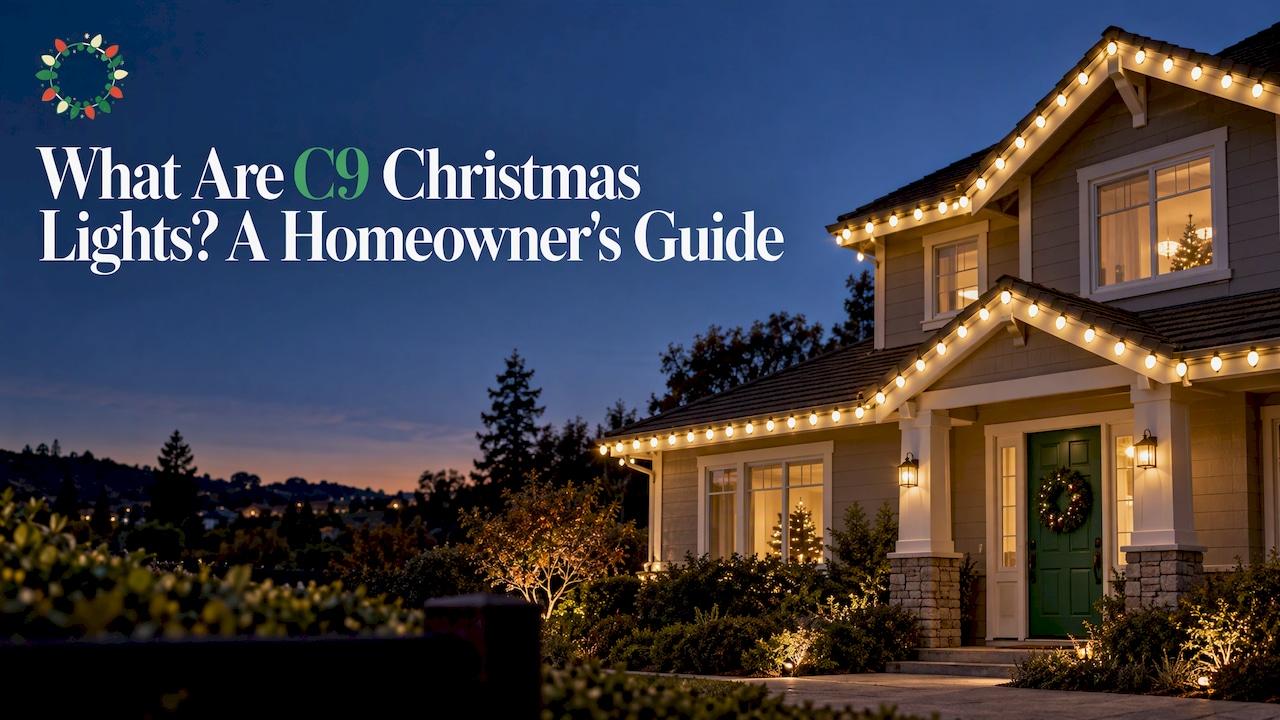
C9 Christmas lights are the large, teardrop-shaped bulbs you see outlining rooflines, eaves and big trees on the best-lit homes and storefronts. "C9" is the bulb's shape and size code, and today most C9 sets are LED, which means a bright, bold look at a small fraction of the old electricity use. If you live or run a business in Sonoma or Napa County and want that look without climbing a ladder, we install custom-cut C9 LED lighting, maintain it through the season and take it down afterward.
TL;DR
- C9 is a bulb size and shape code: a large, cone-shaped bulb on an E17 screw base, built to read clearly from the street.
- C9 LED bulbs draw about 0.8 watts each and carry ratings of tens of thousands of hours, so a long roofline is practical on a normal circuit.
- C9 is not interchangeable with the smaller C7. A C7 will not seat in a C9 socket, so replacements must match.
- Roofline work means ladders and outdoor electrical loads. That is the part most families and property managers prefer to hand off.
- Our Residential installation starts at $600 for Classic, with design, install, maintenance, takedown and storage handled by our team.
Table of Contents
- What does C9 mean in Christmas lights?
- What C9 lights are used for
- C9 vs. C7 vs. mini lights
- C9 LED vs. old incandescent bulbs
- How C9 lights are installed on a roofline
- The ladder problem
- Why professionals use custom-cut C9 runs
- C9 lighting for businesses, wineries and dealerships
- What professional C9 installation costs at our company
- Keeping C9 lights working through the season
- Our view: C9 is a look, and the look depends on the install
- Ready for a roofline you do not have to build yourself
- FAQ
- Sources
What does C9 mean in Christmas lights?
The letter is the bulb's shape. "C" stands for cone, the rounded candle or teardrop profile. The number is the size. Bulbs in this family run from small to large, and C9 sits at the large end of what homeowners commonly use. A typical C9 is about 3 inches tall and screws into an E17 intermediate base that drops into matching socket wire.
The bulb is much bigger than the tiny "mini" lights wrapped on indoor trees, and bigger than the C7 bulb, its closest cousin. That size is the whole point. A large bulb with a wide glow holds its shape from the curb, across a lawn or from a passing car.

If you have seen a line of evenly spaced, individually visible bulbs tracing a gutter, you have almost certainly seen C9s.
What C9 lights are used for
C9 bulbs are made for the outside of a building. Bulb suppliers describe them as a good fit for outlining residential and commercial rooflines and wrapping large evergreens. In practice that covers:
- Rooflines and eaves. The classic use. A single clean line of C9s defines the shape of the house at night.
- Gables, peaks and dormers. Following these edges makes the architecture the display.
- Large trees. Wrapping trunks and major limbs, or draping from the canopy.
- Storefronts, dealership canopies and building perimeters. Where the goal is to be noticed from the road.
- Fences, walkways and driveway borders. Less common, but they work well at larger scale.
For a business, the difference matters. A restaurant, winery tasting room or dealership wants a lit edge that announces the building from a distance. Mini lights read as texture up close. C9s read as an outline from the street.
C9 vs. C7 vs. mini lights
The three sizes are not rivals so much as tools for different jobs. Here is how most people sort them.
| C9 | C7 | Mini lights | |
|---|---|---|---|
| Size | Largest of the three | Medium | Smallest |
| Best for | Rooflines, tall trees, building outlines | Smaller homes, lower rooflines, shrubs | Trees, bushes, wreaths, fine detail |
| Visible from | Far away | Medium distance | Close up |
| Socket compatibility | C9 sockets only | C7 sockets only | Own wiring |
The compatibility row is the one that catches people. C7 and C9 bulbs are not interchangeable: a C7 will not seat in a C9 socket and the reverse is also true. If you inherit a string from a previous owner, check the bulb shape before ordering replacements.
Here is a quick rule for choosing. If your house is two stories, set back from the road, or has a long, low ranch roofline, C9s keep the display from disappearing. If the home is small and the eaves are close to eye level, a smaller bulb can look proportionate. A design walk-through settles this in minutes, and our holiday lighting design guide explains what that planning covers.
C9 LED vs. old incandescent bulbs
For years, C9 meant an incandescent bulb that ran hot and drew serious power. Nearly all new installations now use LED C9s, and the spec sheets show why.
A professional-grade American Lighting C9 LED lists 0.8 watts per bulb, a 50,000-hour rating, 120V operation and an E17 base. The same sheet notes it is dimmable with most compatible dimmers and carries UL listing for indoor and outdoor locations.
What that means for you:
- Lower electricity use. Less than one watt per bulb makes a long roofline a minor load on your home's circuit.
- Longer life. LEDs have no filament to burn out, so you are not chasing dead bulbs mid-season.
- Cooler operation. Less heat at the socket is a safety plus. Our guide to Christmas light fire hazards covers the causes that matter most.
- Durable bulbs. Many commercial LED C9s use a tough polycarbonate lens instead of thin glass.
Color choices are typically warm white, cool white, multicolor and single colors. Warm white is the usual pick for a refined look on wine country homes and tasting rooms. Multicolor suits a playful, traditional display.
How C9 lights are installed on a roofline
This is where the C9 story becomes a labor story. Putting up a good-looking C9 line involves more than clipping bulbs to a gutter.
1. Measure the run. Every edge you want lit, in linear feet, drives both the material and the price. Rooflines with many peaks, dormers and corners add length quickly.
2. Choose the wire and spacing. C9 bulbs sit on stringers with fixed socket spacing. Pre-made sets come in set lengths, which rarely match a real roof. Custom-cut wire is made to the exact length needed, so the run ends where the roof ends. Our post on custom cut Christmas lights explains how that fit works.
3. Attach with clips. Bulbs are held to the gutter, shingle edge or fascia with clips made for the surface. Poor clip choice is a common cause of sagging lines and bulbs that tilt after the first windy night.
4. Point the bulbs consistently. The line looks best when every bulb faces the same way. Uneven direction is the quickest tell of a rushed job.
5. Connect power safely. Plug into a GFCI-protected outlet. The Consumer Product Safety Commission advises plugging outdoor lights into a GFCI-protected receptacle and using lights tested by a nationally recognized testing laboratory. The same page notes that under the fire code, extension cords must be plugged into an approved receptacle or power tap, power taps cannot be daisy-chained, and extension cords cannot be fastened to a structure. Always follow the manufacturer's stated limit for how many strings may be joined end to end.
6. Test before you leave the ladder. Finding a dead section after the ladder is put away means doing it all again.
7. Plan the removal. Outdoor holiday lighting is not meant to stay up indefinitely. NFPA notes that the fire code and the National Electrical Code limit holiday lighting to 90 days. A November install and a January takedown fits comfortably. Our removal guide covers timing.
Where each step goes wrong
Most problems come from the first and last steps. A guessed measurement leaves you with a short string and a dark corner, or a long one with a heap of slack. A takedown done in a hurry leaves tangled wire that costs the following year. Because we cut the wire to your roofline and handle takedown and storage ourselves, those two failure points are off your list.
The ladder problem
Gutter-height work looks easy from the driveway. On a two-story home or a steep Sonoma County hillside lot, it is the riskiest part of the entire project. Setting the ladder on uneven ground, reaching sideways to clip one more bulb and carrying wire up and down are all how weekend decorators get hurt.
Our ladder safety guide walks through setup and three points of contact for anyone who does climb. For most people, the better answer is not to climb at all. Our crew is fully insured and firefighter-owned, and working at height safely is a core part of the job.
Why professionals use custom-cut C9 runs
A store-bought C9 set is built to a standard length and spacing. Real houses are not. Gables, bay windows and garage returns all break the pattern, and you end up with a spare string, an awkward gap or a visible power connection at the wrong spot.
Custom-cut C9 means wire is measured and made to your property. Bulbs land evenly at corners and peaks, and the line follows the building the way an architect would draw it. That precision is what separates a display that looks designed from one that looks assembled.
It also pays off at takedown. Lights labeled and stored by run go back up faster and cleaner when the season comes around again.
If you like that look for a landscape and not only a roof, outdoor landscape lighting installation is the year-round version of the same idea, with fixtures that light trees, paths and walls.

C9 lighting for businesses, wineries and dealerships
The C9 look is especially useful where a building competes for attention.
- Retail and shopping centers. A lit roofline and storefront outline make the building feel open and welcoming after dark.
- Auto dealerships. A bold perimeter reads from the road, which is where shoppers decide to pull in.
- Restaurants, coffee shops and hotels. Warm white lines set the mood before guests walk through the door.
- Wineries and estates. Large rooflines, long fence runs and mature trees need scale, and C9s have it.
- Property managers. One contractor can handle design, install, mid-season service and takedown with clear communication and minimal disruption to tenants.
We cover these through our commercial installation service, winery holiday lighting and estate lighting. Our post on commercial Christmas light installation in Sonoma County goes deeper on planning for business properties.
What professional C9 installation costs at our company
Residential pricing is published. The figures below are the starting points for homes:
| Package | Starting price |
|---|---|
| Per linear foot | from $1 per linear foot |
| Classic | from $600 |
| Signature | from $1,500 |
| Custom Display | from $4,000 |
The final figure depends on your roofline length, the number of trees and features, and the scale of the design. Commercial, estate and winery projects are quoted individually. You can see the residential options on our Residential Christmas Light Installation page.
Keeping C9 lights working through the season
Wind, rain and a squirrel can turn a perfect display into a dark gap. LEDs make failures rare, but they do not eliminate loose connections, tripped outlets or a clip that gave way. If a section goes out, our post on Christmas lights not working lists the usual causes. With our service, in-season maintenance is part of the job, so a dark section gets fixed without you looking for a ladder.
Our view: C9 is a look, and the look depends on the install
We get asked what C9 means more often than you would think, and the answer is simple: it is the bulb that makes a roofline look finished.
What we have learned is that the bulb is the easy part. The look comes from how the line is measured, cut, clipped and powered. That is why we custom cut every run, and why one team handles design, installation, maintenance, takedown and storage.
We are a firefighter-owned, fully insured crew, and safety is built into how we work at height and around power. Our aim is that you enjoy the lights, with no ladder, no tangle and no January chore.
Allen
Ready for a roofline you do not have to build yourself
We design, install, maintain and take down custom-cut C9 LED lighting for homes, businesses, estates and wineries across Sonoma and Napa counties, and we store the lights between seasons. Residential packages start at $600, and you can book from our residential page. If you want to talk through your property, start at abrightservice.com.

We serve Santa Rosa, Windsor, Healdsburg, Napa and Rohnert Park, along with nearby towns.
FAQ
What does C9 mean in Christmas lights?
C9 is a bulb shape and size code. The "C" refers to the cone or teardrop shape, and 9 marks it as one of the larger sizes. It screws into an E17 base and is used for rooflines and large trees.
Are C9 LED lights better than incandescent?
For outdoor displays, LED is the standard choice. A professional C9 LED draws about 0.8 watts per bulb and is rated for 50,000 hours, versus a much shorter life and far higher power draw from older bulbs. They also run cooler at the socket.
Can I mix C7 and C9 bulbs?
No. The two sizes use different sockets, so a C7 will not seat in a C9 socket and vice versa. Replacement bulbs need to match the shape already on your wire. If you are unsure which you have, we can identify it during a design visit.
How many C9 lights can I connect together?
Follow the manufacturer's stated maximum for the specific product, since it varies by wire and bulb. Use a GFCI-protected outlet and avoid daisy-chaining power taps. On a long roofline, our crew plans the power runs ahead of time so no string is overloaded.
Should C9 bulbs point up or down?
Both are used. Down-facing bulbs along gutters are common and look clean from the street, while upward-facing bulbs suit certain peaks and railings. What matters most is that every bulb in a run faces the same way, which is part of how we set up each line.
Sources
- C7 / C9 Christmas Lights
- C7 / C9 LED Christmas Lights
- C9 Replacement Bulbs, Wintergreen Corporation
- American Lighting Premium C9 specification sheet
- CPSC: Put Safety at the Top of Your List When Decorating this Holiday Season
- NFPA: Electrical and Fire Safety Considerations At Home During the Cold Winter Months
- Outdoor landscape lighting installation