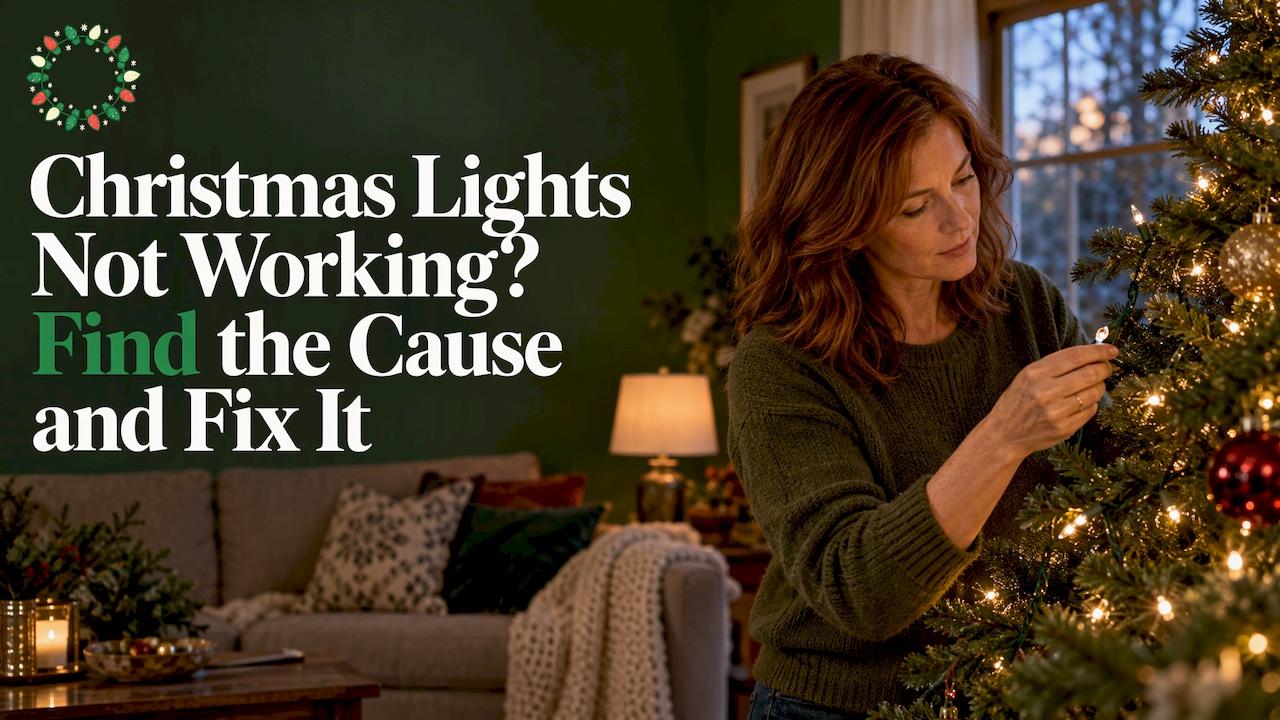
When a string of Christmas lights goes dark, the cause is almost always one of five things: no power at the outlet, a loose or burned-out bulb, a blown fuse in the plug, damaged wire, or too many strands on one run. Work through them from simplest to hardest and you will usually find the problem in 15 minutes. Below is the order we use, what each symptom means (half out, flickering, tripping a breaker, a dead timer), and when to stop and call a professional.
TL;DR
- Check the outlet first: reset the GFCI and confirm the breaker is on before you blame the lights.
- Half a string out usually means one loose or dead bulb near the first dark one. Wiggle it, then swap in a known good bulb.
- A whole string out points to a blown fuse in the plug, a loose plug or damaged wiring.
- Flickering is a loose connection or frayed wire. A breaker that keeps tripping means unplug everything and test one strand at a time.
- Exposed or fraying wire, warm plugs or a burning smell mean the strand goes in the trash, not back on the roof.
Table of Contents
- Start with the power, not the bulbs
- A quick triage: which symptom do you have?
- Fix a whole string that won't light
- Fix half a string that is out
- Fix flickering Christmas lights
- When lights trip the breaker or GFCI
- Timers, smart plugs and pre-lit trees
- Our perspective on lights that keep failing
- Let us handle the roofline
- Replace or repair: a simple rule
- A pre-season habit that prevents most of this
- FAQ
- Sources
Start with the power, not the bulbs
Before you touch a single bulb, make sure electricity is reaching the plug. The Home Depot's troubleshooting guide puts this first: check your main electrical panel to confirm the breaker is on and has not tripped, then look for a tripped GFCI outlet and press RESET.
A quick way to confirm the outlet is live is to plug in something you know works, like a phone charger or a lamp. Lowe's troubleshooting steps use the same test, and they start with unplugging the lights before you handle anything.
Outdoor outlets deserve extra attention. They are usually on a GFCI, and moisture is the most common reason one trips. If the GFCI will not reset with nothing plugged in, the problem is the outlet or the circuit, not your lights. That is an electrician's job.

A quick triage: which symptom do you have?
Ace Hardware sorts light failures into three types: a full outage, a dead section and flickering bulbs. Use the table to jump to the right fix.
| What you see | Most likely cause | First thing to try |
|---|---|---|
| Whole string dark | No power, blown plug fuse, loose plug, wire damage | Test the outlet, then check the plug fuses |
| Half the string out | Loose or burned-out bulb at the start of the dark section | Wiggle the first dark bulb, then swap bulbs |
| Flickering | Loose bulb, weak plug connection, frayed wire | Reseat every bulb, then check the plug and outlet |
| Breaker or GFCI trips | Overloaded circuit, moisture, damaged strand | Unplug all, then add strands back one at a time |
| Timer or smart plug not working | Timer setting, outlet power, wireless or firmware issue | Plug the lights directly into the outlet to test |
Fix a whole string that won't light
If the outlet is live and the whole strand is dark, Lowe's says the likely culprits are a blown fuse in the plug, a loose plug or the wiring. Unplug the strand first to avoid shock.
Check the fuses in the plug
Most strands hide two small fuses in a sliding compartment on the plug. Family Handyman explains that you pull them out and look for a broken filament. If you cannot tell, replace them one at a time with new ones.
Signs of a blown fuse are dark spots, a broken internal filament or burn marks. Ace Hardware advises replacing it with a fuse of the same size, style and rating. Most strands ship with spares in the plug compartment or on the tag.
A fuse is doing its job when it blows. The U.S. Department of Energy explains that fuses in holiday lights open the circuit when current rises past a safe level, which prevents wire melting or fires. If a new fuse blows right away, do not try a bigger one. Retire the strand.
Inspect the plug and the wire
Look for bent or corroded prongs, cracked plastic and exposed copper. Family Handyman warns that broken or fraying wires can stop a strand from working and are a fire hazard. Its advice is to replace the lights right away and recycle the old strand.
Fix half a string that is out
Half a strand dead is the classic Christmas light problem, and it is usually the easiest to solve.
USA Today's walkthrough says a half-lit strand probably has a loose or broken bulb. Here is the process:
- Unplug the strand.
- Find the first unlit bulb. Family Handyman notes the bad bulb is often the first one that is dark.
- Wiggle it gently to make sure it is seated. Plug in and see if the section flickers or lights.
- If not, go down the row of unlit bulbs, swapping each for a known good bulb until the strand comes back. USA Today describes exactly this method.
- Once the strand lights, keep the spare bulbs and fuses with the box.
A non-contact voltage tester or a dedicated light tester speeds this up a lot on long strands. Family Handyman calls a light tester the easiest and fastest way to find the trouble spot.
Why one dead bulb can darken so many
Older incandescent mini lights are wired in series, with a small shunt under each filament meant to keep the rest burning. According to the Department of Energy, when a filament burns out the heat melts the insulating coating on the shunt so current passes around it. When that shunt does not work or a bulb is simply missing or loose, the circuit breaks and everything beyond it goes dark.
Do not ignore a dead bulb on an otherwise working strand. USA Today cautions that the remaining bulbs can be handling excess voltage, which shortens their life.
Fix flickering Christmas lights
Flickering means an unreliable connection somewhere. Start simple.
- Reseat every bulb. Lowe's suggests gently wiggling each bulb to make sure it is firmly in place.
- Check the plug and outlet. If the whole strand flickers, the plug-to-outlet connection may be weak. Try a different outlet.
- Think about wind. HowToGeek notes that very irregular flicker on outdoor incandescent lights suggests frayed wires moving in the breeze.
- Replace the strand if the plug is secure and it still flickers. Lowe's says replacement is the best option when you can do it.
On LED strings the cause can also be a bad connector or a failed rectifier, as The Home Depot lists. Many LED strands have tiny lights embedded in a thin cord that cannot be swapped out individually, according to Fixr's comparison. So when an LED strand fails past a loose connection, the practical fix is a new strand.
Do LEDs burn out? Rarely compared with incandescents. Fixr puts LED life around 50,000 hours against roughly 1,000 for standard bulbs, though both can break when hit.
When lights trip the breaker or GFCI
A tripping breaker is a warning, not a nuisance. The CPSC's home wiring guide lists dim or flickering lights, frequent fuse replacements or breaker resets, and overheated plugs, cords or outlet covers as signs of potential electrical hazards.
Find the offending strand
Use an isolation test:
- Unplug everything from that circuit, including extension cords and timers.
- Reset the GFCI or breaker. If it trips with nothing connected, the problem is the outlet or the circuit. Call a licensed electrician.
- Plug in one strand or cord at a time, waiting about 30 seconds between each.
- When it trips, you have found the culprit. Inspect that strand for damage, cracked sockets or wet connections.
If an outdoor GFCI will not reset or keeps tripping, Brothers Plumbing advises unplugging the decorations and having the circuit inspected, since moisture, damaged equipment or an electrical fault may be behind it.
Too many lights on one outlet
Overloading is the other common cause. The CPSC guide says total watts on a branch circuit at one time should stay under 1,500 or 2,000 watts, and that you should move load to another circuit if you exceed it.
Strand limits matter too. The Home Depot says most incandescent mini-light sets should not be connected end to end more than 3 strands, while LED strings can usually run much longer because they draw less current. Always check the tag for the manufacturer's maximum. Popular Mechanics gives the same three-strand rule for mini lights unless the manufacturer allows more.
Warning signs of an overloaded circuit, per Brothers Plumbing, include a breaker that trips repeatedly, warm outlets or plugs, buzzing or crackling near an outlet, a burning smell and discoloration around a plug. If you notice any of those, unplug everything and have an electrician look at the circuit.
Moisture and outdoor connections
Water in a plug, socket or cord can trip a breaker. Family Handyman recommends outdoor-rated extension cords and waterproof covers for outdoor sockets. Keep plug-to-plug connections off the ground and out of puddles, and use insulated clips or hooks rather than nails or staples, which can pierce the cord insulation, as Popular Mechanics advises. For more on keeping outdoor lighting setups electrically safe, see this guide to outdoor lighting electrical safety.

The stakes are real. Popular Mechanics reports, citing FEMA, that electrical problems account for nearly a third of Christmas tree-related home fires.
Timers, smart plugs and pre-lit trees
Timer not working. Take the timer out of the picture: plug the lights straight into a working outlet. If they light, check the timer's program, its on/off pins or settings and its own power. If they do not, go back to the strand checks above. For smart lights, The Home Depot lists Wi-Fi, Bluetooth and firmware problems as possible causes.
Top of a pre-lit tree dark. If only the top section is out, it is usually a connector. The fix, per Christmas Tree World, is to disconnect the top section, reconnect it firmly, check that the connector pins are not bent and inspect the bulbs for damage or loose fittings. Lowe's notes that strands on pre-lit trees typically cannot be replaced.
Our perspective on lights that keep failing
We install and maintain holiday lighting across Santa Rosa and Sonoma County, so we see the same pattern every December: a strand that worked fine in the box goes dark once it is on a roofline, a wet gutter or a tall tree.
Most of those failures are not the lights' fault. They come from lights stretched on a ladder in a hurry, tangled connections, too many strands on one outlet or cords left where rain collects. That is why we treat lighting as a whole job: design, custom-cut C9 LED lights sized to your property, professional mounting, in-season maintenance and careful takedown and storage.
Custom-cut means the run fits your roofline, so there are fewer loose ends and extension cords to fail. A fully insured, firefighter-owned crew means the ladder work, and the safety thinking behind it, is not on you. If something goes dark in season, you call us. You do not climb up to wiggle bulbs in the cold.
The simple fixes in this article are worth knowing for the lights on your tree and mantel. For the roofline, the gutters and the big trees, we would rather you enjoy them from the sidewalk.
Allen
Let us handle the roofline
If you are tired of testing bulbs on a ladder, we take the whole job off your list. Residential installation is from $1 per linear foot, with packages starting at $600 for Classic, $1,500 for Signature and $4,000 for Custom Display. Every package covers custom-fit C9 LED lighting, professional installation, in-season maintenance, takedown and storage. See residential Christmas light installation for what each package includes.

Businesses, estates and wineries have their own pages: commercial holiday lighting, estate lighting and winery holiday lighting. Those projects are quoted individually. If you also want clean gutters before lights go up, ask about our gutter cleaning. Our work covers Santa Rosa, Windsor, Healdsburg, Rohnert Park, Napa and surrounding Sonoma County towns.
Replace or repair: a simple rule
Repair when the cause is a loose bulb, a blown fuse or a dead bulb you can swap. Replace the strand when you see any of the following:
- Bare copper, cracked insulation or chewed cord.
- Melted or discolored plastic at the plug or sockets.
- A new fuse that blows immediately.
- A strand that trips the GFCI on its own after you have dried it out.
- An LED strand with embedded lights that stay dark after you have checked the plug and connections.
When you replace, check the tag for indoor or outdoor rating and the maximum number of connected strands. Recycle the old strand rather than leaving it in the box for next year.
A pre-season habit that prevents most of this
Test every strand on the ground before it goes up. Lay it out, plug it in, fix dead sections while you are comfortable and warm, then hang it. Keep a labeled bag with spare bulbs and fuses. Store lights loosely wound, not wadded, and keep them away from damp garages. It takes an hour and saves a cold evening.
FAQ
Why are half of my Christmas lights out?
Usually one bulb in the dead section is loose or burned out. Unplug the strand, find the first unlit bulb, wiggle it and plug back in. If nothing changes, swap each unlit bulb for a known good one until the strand relights.
Why do my outdoor Christmas lights keep tripping the breaker?
The usual causes are moisture in a plug or socket, a damaged strand or too many lights on one circuit. Unplug everything, reset, and add strands back one at a time. If it trips with nothing plugged in, or the GFCI will not reset, have an electrician inspect the circuit.
Can I still use a strand with one bulb out?
You can, but fix it soon. USA Today notes that the remaining bulbs on a strand with a dead bulb can face excess voltage, which shortens their life. If you see exposed wire or damaged plugs, do not use it at all.
Why are my Christmas lights flickering?
Most often a bulb is loose, the plug is not seated well or a wire is frayed. Reseat each bulb, try another outlet, and inspect the cord. If it still flickers and the plug is secure, replace the strand.
Sources
- How to Fix Holiday Lights, The Home Depot
- How to Fix Christmas Tree Lights, Lowe's
- How to Fix Christmas Lights That Are Not Working, Ace Hardware
- Why Are My Christmas Lights Not Working, Family Handyman
- Broken Christmas lights: How to fix bulbs and strands, USA Today
- How Do Holiday Lights Work?, U.S. Department of Energy
- Why Are My Christmas Lights Flickering?, HowToGeek
- LED vs Regular Christmas Lights, Fixr
- CPSC Guide to Home Wiring Hazards
- Are Your Holiday Lights Safe?, Popular Mechanics
- Overloaded Circuits and Holiday Lights, Brothers Plumbing
- How to Troubleshoot a Pre-Lit Christmas Tree, Christmas Tree World
- Outdoor lighting electrical safety