
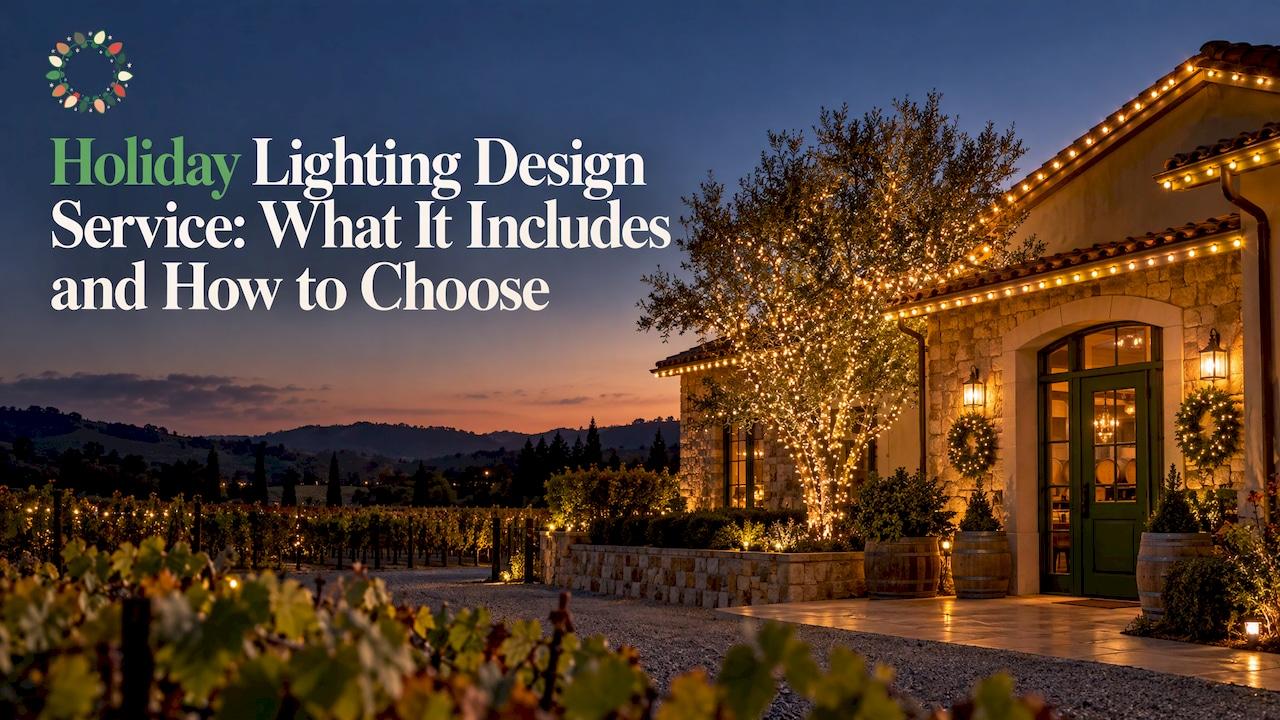
A holiday lighting design service plans the look of your lights for your specific property, then handles the materials, installation, in-season upkeep, takedown and storage. You approve the plan and the crew does the rest. This guide explains what each stage involves, what a good package should spell out, how pricing works, and when to book. We are A Bright Service, a firefighter-owned Christmas light company serving Santa Rosa, Sonoma County and Napa.
TL;DR
- Design means a plan made for your roofline, trees, entry and landscape, not a box of lights hung wherever they fit.
- A true turnkey package covers design, custom-cut lights, installation, in-season maintenance, takedown and storage under one contract.
- Our residential packages start at $600 (Classic), $1,500 (Signature) and $4,000 (Custom Display), or from $1 per linear foot.
- Ask what is included before you sign: who fixes a dark section, who removes the lights, and where they are stored.
- Book early. Calendars fill as Thanksgiving approaches, and the best design choices are made before the rush.
Table of Contents
- What a holiday lighting design service actually is
- How the design process works, step by step
- What a good package includes
- Why custom-cut C9 LED lighting matters
- Residential packages and what they cost
- Safety is part of the design
- Homes, estates, wineries and businesses
- Perspective: why we design before we hang
- How to book, and when
- What to confirm before work begins
- Plan your design with us
- FAQ
- Sources
What a holiday lighting design service actually is
Plenty of people can hang lights. Design is the part that decides what gets lit, in what color, at what spacing and with what focal point, so the finished property looks intentional from the street.
A design service treats your home or business the way a lighting designer treats a small project. It looks at the architecture, the viewing angles, the trees and the power available. It then turns that into a plan you can approve before anyone climbs a ladder.

The alternative is the familiar result: strands bought one at a time, mismatched whites, a dark gap where the cord ran short, and a weekend lost to ladders. Most disappointing displays fail for lack of a plan, not lack of lights.
How the design process works, step by step
Every company runs it a little differently, but a professional process usually follows the same arc.
- Consultation. You describe what you want: classic warm white, a colorful family look, a polished storefront. You also share your budget and whether you want maintenance and takedown included.
- Property review. The designer walks the property and looks at rooflines, gutters, eaves, windows, columns, trees, shrubs and where the outlets are. Looking at the property after dark is ideal, because that is how it will be seen.
- Concept. The designer decides on a focal point, the zones to light and the color plan. A front entry, a gabled roofline or a signature oak might lead, with the rest supporting it.
- Measurement and plan. Run lengths are measured so lights can be cut to fit and the price is based on real footage, not a guess.
- Installation. A trained crew mounts the lights with professional clips and hangers, sets timers and checks every section lit.
- Maintenance through the season. If a section goes dark or a strand shifts in wind, the crew returns to fix it.
- Takedown and storage. The lights come down carefully after the holidays and are stored, so you do not face a tangled box next November.
Steps 4 through 7 are where full-service providers differ most from a one-time hanging job.
What a good package includes
When a company says "full service" or "turnkey," read that as a checklist rather than a slogan. Here is what we think a complete package should spell out in writing.
| Item | What to look for |
|---|---|
| Design | A plan for each zone, not a generic template |
| Lights | Commercial-grade LEDs, cut to the lengths your property needs |
| Installation | Professional mounting that does not rely on nails or staples |
| Maintenance | Repairs during the season at no surprise charge |
| Takedown | A set period for removal after the holidays |
| Storage | Where the lights are kept and who owns them |
| Insurance | Proof the crew is insured for work on your property |
Our own approach combines all of these under one service: design, installation, in-season maintenance, seasonal takedown and storage. Our lights are custom-cut C9 LEDs, so each run fits your roofline instead of bunching up at the end or falling short.
Why custom-cut C9 LED lighting matters
C9 bulbs are the larger, bolder bulbs people picture when they imagine a classic rooflines look. On a home or storefront they read clearly from the street, which is the point of a display.
Custom cutting means the strand is made to the length of the run it will cover. For you, that means clean lines, fewer visible cords and fewer connection points that can fail. LEDs also draw far less power than older incandescent strings, which matters when you run a display for weeks.
If you want to coordinate your lights with the rest of your yard, such as pathways, shrubs and permanent fixtures, landscape lighting ideas can help you think about how warm white holiday lighting sits alongside your year-round lighting. A designer can then match color temperature so the two do not clash.

Residential packages and what they cost
We publish our residential starting prices because a design conversation is easier when you know the range.
| Package | Starting price |
|---|---|
| Per linear foot | from $1 |
| Classic | from $600 |
| Signature | from $1,500 |
| Custom Display | from $4,000 |
The final price depends on the footage, the number of zones, the height and complexity of the roofline, and how much of the property you want lit. A single-story ranch with a simple roofline is a different project from a two-story home with dormers, mature trees and a long driveway.
You can see how our tiers are laid out on our residential Christmas light installation page. Commercial, estate and winery work is quoted per property, because those jobs vary so widely in scale. We do not publish a price for them.
What drives the price of any lighting project
- Linear footage. More roofline, more fence or more trees means more lights and more labor.
- Height and access. Taller buildings take more time and more equipment.
- Design complexity. Wrapped trunks, wreaths, multiple colors and layered zones take more planning.
- Services included. Maintenance, takedown and storage are part of the value, not afterthoughts.
When you compare quotes, compare what is included, not only the headline number. A low price that excludes takedown or repairs can end up costing more.
Safety is part of the design
Our team is firefighter-owned, so we take the risks of holiday decorating seriously. They are real. The Consumer Product Safety Commission reported that about 14,900 people were treated in hospitals for holiday decorating injuries in a recent season, and nearly half involved falls. Ladders are a big part of that, which is why hiring a trained, insured crew is often the safer path. Our guide to ladder safety for Christmas lights goes deeper if you still plan to do some of the work yourself.
Electrical safety belongs in the plan too:
- Decorative lighting should be listed and labeled, and light strings are evaluated under UL/ANSI 588. The National Electrical Code also treats holiday lighting as a temporary installation of no more than 90 days, which is one reason prompt takedown matters.
- Fire departments respond to an estimated average of 832 home fires a year related to holiday decorations, excluding Christmas trees, according to NFPA figures cited by UL Solutions. Damaged cords, overloaded outlets and poor connections are the usual trouble spots.
- Outdoor displays belong on GFCI-protected outlets, and mounting hardware should avoid nails and staples that can damage wiring or siding. A designer who plans the power layout up front avoids overloaded circuits.
If you have an older home with limited outdoor outlets or you are unsure about your circuits, ask a licensed electrician to look at them before the season. A lighting crew can tell you where it will plug in, but your electrical panel is a question for an electrician.
Homes, estates, wineries and businesses
The design questions change with the property.
Homes
The goal is a warm, welcoming look you enjoy with the family, without weekends on a ladder. Most homeowners start with the roofline and entry, then add trees, windows or wreaths. Our Santa Rosa, Windsor, Healdsburg and Rohnert Park pages show where we work locally.
Estates and wineries
Larger grounds call for scale: long drives, specimen trees, tasting rooms, barrel rooms and event spaces. The design has to look good in photos guests take and also hold up through the season. See our pages for estate holiday lighting and winery holiday lighting.
Retail, dealerships, restaurants and commercial properties
A storefront or dealership needs to be seen from the road and feel welcoming at the door. Property managers also care about communication, minimal disruption to tenants and customers, and a clear removal date. Our commercial holiday lighting service handles design, installation, maintenance, removal and storage so your staff does not have to. For more on how this works locally, read our guide to commercial Christmas light installation in Sonoma County.
Commercial clients commonly ask for a certificate of insurance before work starts. Ask any provider for one, and expect to share building access details, outlet locations and any quiet hours for tenants.
Perspective: why we design before we hang
We have seen the same pattern for years. A homeowner buys lights, spends a Saturday on a ladder and ends up with something that is fine up close and flat from the street. The lights were never the problem. The missing piece was a plan.
That is why we start with the property, not the product. We look at the roofline, the trees, the entry and how people will see the house as they drive up. Then we cut the C9 LED lights to fit those runs, so the lines are clean and nothing is improvised on the day.
We are firefighter-owned, and that shapes how we work. We would rather you stay on the ground. Our crew is fully insured and experienced, and we handle the mounting, the in-season upkeep, the takedown and the storage ourselves. You enjoy the display. We carry the work.
That all-in-one approach is what we think a design service should be. Design without installation leaves you holding the hard part, and installation without design leaves you with an ordinary result.
Allen
How to book, and when
Design takes time, and so does fitting your property into a crew's schedule. The earlier you reach out, the more choice you have over the look and the install window. Waiting until the week of Thanksgiving narrows your options, and it usually means a simpler display because there is less time to plan and order.
Here is a simple timeline to work from:
- Request a consultation. Tell us about the property and the look you want.
- Review the plan and price. Confirm the zones, the lights and what is included.
- Install. The crew mounts and tests everything. You do not need to be home for most exterior work, though it helps to share gate codes and outlet locations.
- Enjoy the season. If something goes dark, call and we return.
- Takedown and storage. We remove the lights after the holidays and store them for next year.
The length of an installation depends on the size and complexity of the property. Ask for an estimated time on site when you get your quote. For this season's availability, check with us directly rather than counting on a posted schedule.
What to confirm before work begins
Whichever provider you hire, get these answers in writing. They protect you and make the whole job smoother.
- What is covered by the price? Design, lights, installation, repairs, takedown and storage should each be named.
- Who owns the lights? In a full-service model the lights are typically the provider's and stay in storage. Confirm how that works for your contract.
- What is the repair policy? Find out how quickly a dark section gets fixed and whether there is a charge.
- When do the lights come down? Ask for a window. Holiday lighting is meant to be temporary, and prompt removal protects your wiring and your roof edge.
- Is the crew insured? Ask for proof, especially for commercial and estate properties.
- What happens with weather or access issues? A good provider has a plan for rain delays, locked gates and pets.
- Can it bundle other exterior work? Some customers pair lighting with gutter cleaning so gutters are clear before lights go on. We offer gutter cleaning as a bundled service.
Plan your design with us
If you want a display that looks planned, is installed safely and comes down without a fuss, we can take it from the first sketch to the storage bin. We serve homes, businesses, estates and wineries across Santa Rosa, Sonoma County and Napa, with design, custom-cut C9 LED lighting, installation, maintenance, takedown and storage in one service.

Start with our residential installation page to see the packages, or visit A Bright Service to request a consultation for your home or business.
FAQ
What is the difference between holiday lighting design and installation?
Design is the planning: what to light, in what colors, with what focal point and how it is powered. Installation is the physical work of mounting and testing the lights. In a full-service package the same company does both, which is why the result looks consistent.
What does a turnkey holiday lighting service include?
A turnkey service should cover the design, the lights themselves, installation, in-season maintenance, takedown and storage. At A Bright Service, those pieces come together in one contract, so you are not coordinating separate vendors. Always confirm each item in your written quote.
How much does professional holiday lighting cost with us?
Our residential packages start at $600 for Classic, $1,500 for Signature and $4,000 for Custom Display, or from $1 per linear foot. Your final price depends on footage, height, complexity and what you want lit. Commercial, estate and winery projects are quoted individually.
Do I need to be home during installation?
Usually not for exterior work. We just need access to the areas being lit and to know where the outlets are. Tell us about gates, pets and any times that work best for your household or your business.
When should I book?
As early as you can. Earlier booking gives you more choice in design and install timing, and it avoids the pressure of late November. Contact us for current availability rather than relying on a general schedule.
Sources
- USA Today: Fires, electrocutions, falls: tips to avoid dangerous holiday hazards
- IAEI Magazine: Holiday Lighting, Display Safety and the NEC
- UL Solutions: Safe Lighting Tips to Keep the Season Bright
- Landscape lighting installation