
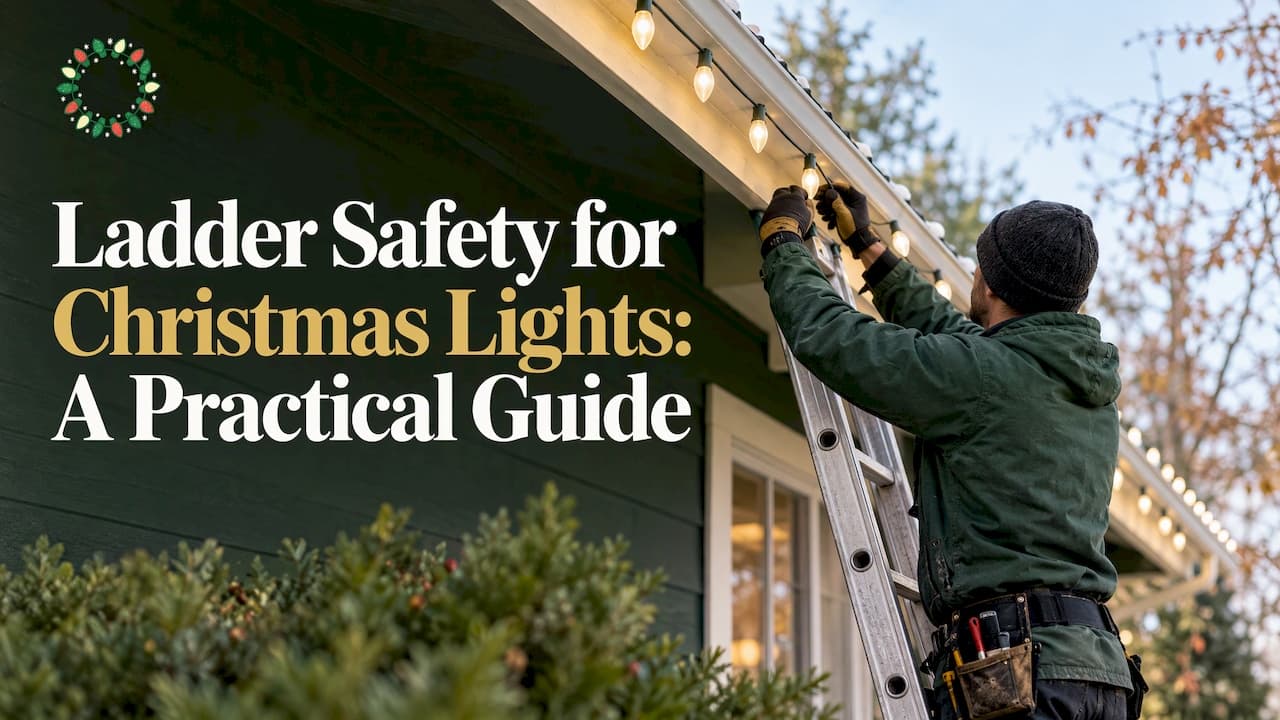
To hang Christmas lights safely from a ladder, set it on firm, level ground at the right angle, keep three points of contact, extend it three feet above the roofline, stay away from power lines, and skip the job in wind, rain or ice. If any of that is out of reach, you can decorate without ladders: use ground-level tricks, or hire a crew to do the climbing. Below are the specific numbers and checks, then the no-climb options.
TL;DR
- Set the base one foot out for every four feet of ladder height (about a 75-degree angle), on stable, level ground.
- Keep three points of contact, face the ladder, stay between the rails, and never stand on the top rungs.
- Extend the ladder at least three feet above the roof edge and keep it and your tools at least 10 feet from power lines.
- Do not climb in high wind, rain, ice or snow. Plan a no-ladder option, or a professional, for steep or tall rooflines.
- Net lights, extension poles and ground-level displays cover a lot of a yard without leaving the ground.
Table of Contents
- Why ladders deserve respect at holiday time
- Choose the right ladder before you climb
- Set it up: angle, ground and height
- Climb and work without falling
- Check the hazards around the ladder
- Fasten lights without damaging anything
- How to decorate without ladders
- When to hand the roofline to a professional
- What professional installation covers
- Book your Sonoma County installation
- A quick pre-climb checklist
- FAQ
- Sources
Why ladders deserve respect at holiday time
Most people use a ladder a few times a year, and December is often one of those times. That is when mistakes happen: a rushed afternoon, a borrowed ladder, one more strand to reach.
The CDC's national estimates of holiday decorating falls found that 62% of fall-related injuries tied to decorating happened among young and middle-aged adults. These are not only older homeowners. The Illinois Department of Labor's holiday decorating guidance cites the Electrical Safety Foundation figure of roughly 5,800 emergency room visits a year from falls involving holiday decorations.
The CPSC says the same thing in plain terms in its holiday decorating release: use caution when standing on a ladder or a chair to hang decorations. The rest of this guide turns that caution into steps.
Choose the right ladder before you climb
Match the ladder type to the job
A stepladder is self-supporting. It is not meant to lean against a wall, because its foot pads are not built for that. The OSHA holiday decorating guidelines say so directly. For gutters and eaves you want a straight or extension ladder. For a porch rail or a low window, a stepladder used open and locked is the right tool.
Never stand on a chair, a box, a barrel or a piece of furniture. The University of Wisconsin's environmental health and safety office advises using a proper step stool or ladder for high places instead.
Check the load rating
Your weight plus everything you carry (tools, clips, a coil of lights) counts toward the ladder's rating. OSHA's extension ladder fact sheet tells you to follow the manufacturer's instructions, add up your weight and your load, and never exceed the rating. It also says never to tie two ladders together to make them longer.
Inspect it first
Look at the rails, rungs, feet and locks before every use. OSHA calls for a competent person to inspect extension ladders before use and for defective ladders to be tagged and taken out of service. At home, that competent person is you. Check for:
- Bent or cracked rails and loose or damaged rungs
- Worn or missing foot pads
- Rung locks (dogs or pawls) that do not seat firmly
- Oil, grease, paint or mud on the rungs and rails. OSHA's Stairways and Ladders publication says to keep ladders free of slipping hazards.
The same ladder you use for the lights is probably the one you use on your gutters. A seasonal gutter checklist is a good prompt to give the ladder and the gutter line a look before you attach anything to them.
Set it up: angle, ground and height
The 4-to-1 rule and the 75-degree test
The base should sit one foot away from the wall for every four feet of height the ladder reaches. OSHA's fact sheet states the same thing as one quarter of the working length. The CDC report gives the same ratio.
No tape measure handy? The CPSC's Ladder Safety 101 describes a quick check for the 75-degree angle. Stand upright with your toes against the feet of the ladder and reach straight out. Your palms should land on the rung at shoulder level.
Stable, level ground
Both rails must rest evenly on firm ground. OSHA's list of prohibited actions includes setting a ladder on soft ground or unstable footing, or on boxes or barrels. Wet lawn, loose mulch and sloped flower beds are the usual trouble spots around a house. If the ground is uneven, pick a different spot or a different approach. Do not stack something under one leg.
Three feet above the roof edge
When the ladder reaches a roof or a landing, the rails should extend at least three feet above it, so you have something to hold when you step on or off. Cal/OSHA's portable ladder guide says the side rails should extend 36 inches or more above the upper landing. If that is not possible, the ladder must be secured at the top to a rigid support, with a grab rail provided.
For a gutter-line job where you never step onto the roof, you are still working against the same geometry. A ladder that is too short makes you stretch, and stretching is how people fall. If you are working near a roofline, a guide to extending your roof's lifespan is worth a read, because it explains what the roof edge and surface can and cannot take.
Doors, driveways and foot traffic
If the ladder stands in front of a door, block or lock the door and post a note so no one opens it into you. OSHA's Stairways and Ladders publication says ladders in passageways, doorways or driveways should be secured, or the area barricaded. The University of Wisconsin makes the same point about doors. Keep kids and pets clear of the base, and keep the area around the top and bottom free of clutter.
Climb and work without falling
Three points of contact
At all times, two hands and one foot, or two feet and one hand, are on the ladder. Face the ladder going up and coming down. OSHA's fact sheet also tells you to keep your body inside the side rails. The CDC report says the same, advising you to stay centered between the rails.
That has a practical consequence for lights: you cannot hold a strand and a clip box and a drill with your hands while climbing. OSHA suggests carrying tools in a tool belt or raising them with a hand line.
Do not lean, do not overreach
Leaning out past the side rails is on OSHA's list of prohibited actions, and so is moving or shifting a ladder with a person on it. When the next clip is out of reach, climb down and move the ladder. It takes twenty seconds. A fall takes much longer to recover from.
Watch your rungs
The CPSC advises not standing on the top three rungs of a straight or extension ladder. The CDC report says not to stand on the top two. Pick the stricter rule. Only one person goes up at a time, and a helper should hold the bottom.
Check the hazards around the ladder
Power lines
Before you raise a ladder, look up. OSHA's fact sheet tells you to survey for energized overhead lines and to keep ladders and tools at least 10 feet from them. Aluminum and wet wood conduct electricity. If the ladder or you could touch exposed energized equipment, OSHA says to use a ladder with nonconductive side rails. In practice, if the service drop to your house crosses the spot you need, change the plan.
Weather
Cal/OSHA says never to set up or use a ladder in high wind, especially a lightweight metal or fiberglass one, and not to use ladders on ice or snow unless absolutely necessary. North Bay winter storms often bring wet roofs and gusty days, so choose a dry, calm window. Dry weather also helps the lights: you are handling cords outdoors.
Electrical load and cords
The fall is not the only risk. The Illinois guidance notes that extension cords are not a substitute for permanent wiring, with a written exception for temporary holiday decorations, and that temporary wiring should be inspected before each use. Check every strand for cracked insulation and loose plugs before it goes up, not after it is attached to the second story.

Fasten lights without damaging anything
Use clips, hooks or holders made for Christmas lights. Nails, staples and tacks can pierce wire insulation, which is why the safety advice in the top results consistently warns against them. Clips that fit your gutter or shingle line also mean fewer trips up the ladder, because they stay put through wind.
How to decorate without ladders
If you would rather not climb, there is plenty you can do from the ground.
- Net and grid lights. The Mighty's holiday decorating tips point out that grid or net lights can be draped over trees and bushes without a ladder.
- Extension pole hooks. Family Handyman's tips for hanging Christmas lights describe a hook made from a coat hanger or heavy wire attached to a paint-roller extension pole, used to place lights on tall trees from the ground.
- Ground-level focal points. Lit wreaths on the door, pathway lights, porch rail wraps and wrapped planters carry a lot of visual weight below shoulder height.
- Indoor lights. String lights in a window, on a shelf or in a vase give a festive look from the street without any exterior work.
The roofline is the part that usually needs height, and it is the part people notice first from the road.
When to hand the roofline to a professional
Some jobs are not worth the risk of doing yourself. Think about hiring out when:
- The roofline is two full stories or more.
- The roof is steep, or the surface is slick, wet or covered in moss.
- You have a balance issue or a medical condition that affects exertion. Ask your doctor if you are unsure.
- The work needs electrical changes beyond plugging into an existing outlet. That is a job for a licensed electrician.
- The weather has turned wet, icy or windy.
- You have a large property, such as an estate, winery or storefront, with many access points.
Our perspective on ladders and holiday lights
We are firefighter-owned, and that shapes how we look at a ladder. Firefighters spend years learning that falls usually come from small shortcuts: a ladder set a little too steep, a reach a little too far, a rushed climb in poor light.
Most of our customers in Sonoma and Napa counties are not reckless. They are busy. They have a roofline that is higher than they would like, a calendar that is full, and a box of tangled lights from last year. The honest answer for many of them is that the safest way to do roofline lighting is to have a trained, insured crew do the climbing.
That is why our service covers the whole season: design, installation with custom-cut C9 LED lights, in-season maintenance, takedown and storage. One crew and one set of ladder trips means you are not climbing in January to take it all down either.
If you want to do part of it yourself, do the ground-level parts. Wrap the shrubs, light the walkway, dress the front door. Leave the eaves to us.
Allen
What professional installation covers
A professional installer handles the pieces that create the most ladder time: measuring, mounting, the in-season fix when a strand fails, and takedown. Our residential service at A Bright Service is built around custom-cut C9 LED lights, so each run fits the roofline instead of hanging in slack loops or leaving a bare stretch.
Published starting prices for residential installation, as listed on our site:
| Package | Starting price |
|---|---|
| Per linear foot | from $1 |
| Classic | from $600 |
| Signature | from $1,500 |
| Custom Display | from $4,000 |
Commercial, estate and winery projects are quoted individually. We also offer gutter cleaning, which can be bundled with lighting so the ladder work happens in one visit.
Book your Sonoma County installation
If your roofline is out of your comfort zone, we can design, install, maintain and take down your lights, fully insured, from Santa Rosa to Napa. Start with the residential installation page to see the packages. Business owners can look at our commercial holiday lighting service. We also work in Santa Rosa, Windsor, Petaluma and Healdsburg.

Book early. Installation calendars fill up as the season approaches, so check the site for current availability.
A quick pre-climb checklist
- Check the forecast: dry and calm.
- Inspect the ladder: rails, rungs, feet, locks, clean surfaces.
- Look up for power lines and stay at least 10 feet away.
- Set it on firm, level ground at the 4-to-1 angle.
- Extend it three feet above the roof edge if you are stepping off.
- Block doors and keep the base clear, with a helper holding it.
- Use a tool belt or hand line so both hands stay free.
- Keep your hips between the rails and climb down to move the ladder.
FAQ
How far should a ladder be from the house when hanging lights?
Place the base one foot from the wall for every four feet of height. That gives roughly a 75-degree angle. The CPSC suggests a quick check: stand with your toes at the ladder's feet and reach out. Your palms should touch the rung at shoulder level.
Can I use a stepladder to reach the gutters?
A stepladder works only when it is fully open and locked, and it should not be leaned against the wall like an extension ladder. The OSHA holiday guidance says its foot pads are not intended for leaning. For gutter-height work you generally need a properly sized extension ladder, or a professional.
How can I decorate for Christmas without ladders?
Use net lights over shrubs, an extension pole hook for tall branches, and ground-level features like wreaths, wrapped railings and pathway lights. Indoor window lights also read well from the street. For rooflines, hiring an installer removes the climbing entirely.
Is it safe to hang lights in the rain or wind?
No. Cal/OSHA advises never setting up or using a ladder in high wind, especially a lightweight metal or fiberglass one, and avoiding ice and snow. Wet cords and plugs add an electrical risk. Wait for a dry, calm day.
How much does professional Christmas light installation cost?
Our published residential starting prices are from $1 per linear foot, from $600 for Classic, from $1,500 for Signature and from $4,000 for Custom Display. Final pricing depends on your property. Commercial, estate and winery projects are quoted individually.
Sources
- CDC Morbidity and Mortality Weekly Report on holiday decorating falls
- OSHA extension ladder fact sheet (OSHA 3660)
- OSHA Stairways and Ladders (OSHA 3124)
- Illinois Department of Labor, OSHA holiday decorating guidelines
- CPSC holiday decorating safety release
- CPSC Ladder Safety 101
- Cal/OSHA portable ladder safety guide
- University of Wisconsin, ladder safety for holiday decorating
- The Mighty, holiday decorating tips
- Family Handyman, tips for hanging Christmas lights