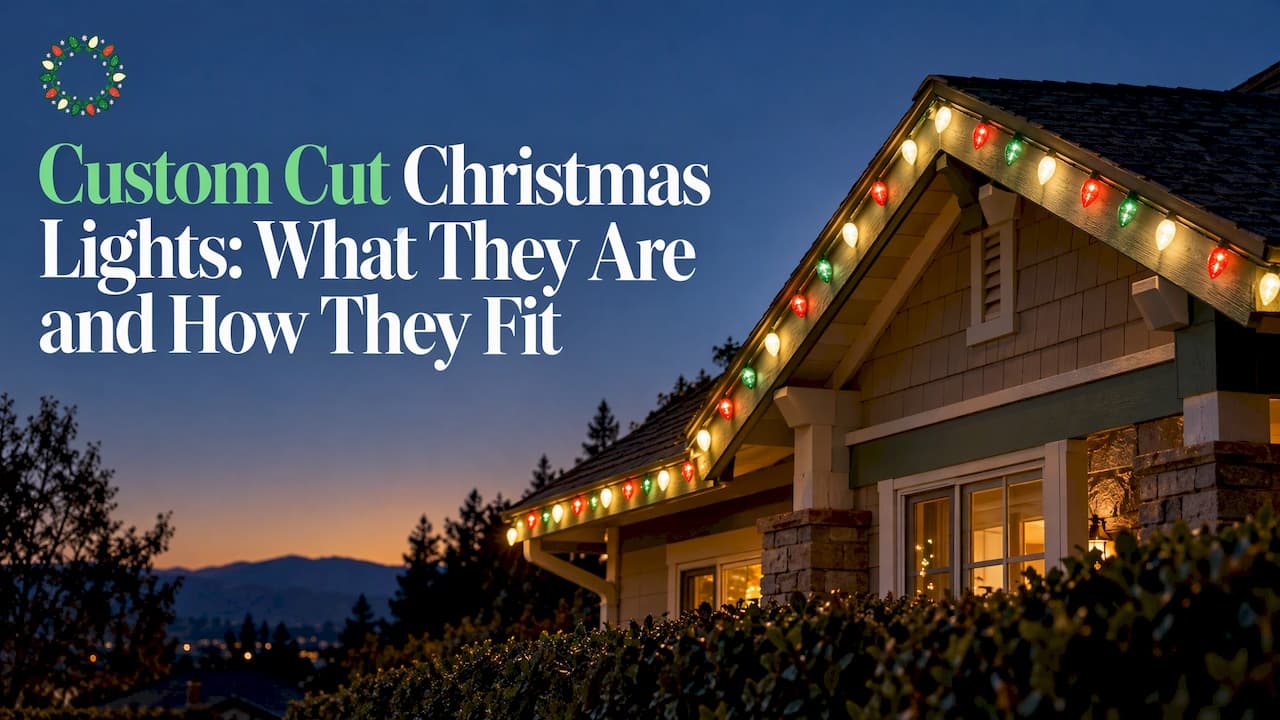
Custom cut Christmas lights are socketed light line that is trimmed to the exact length of your roofline, windows or railings, so there is no dangling extra cord and no gap at the corner. Only one type of light is built for this: parallel-wired commercial C7 and C9 socket cord. Ordinary store-bought strands are not. Below, we explain how the difference works, how a custom run is measured and built, and what a professional installation covers.
TL;DR
- Only parallel-wired commercial C7 and C9 socket cord is meant to be cut. Standard mini-light and LED strands generally should not be.
- A custom run starts with measuring every roofline section, then adding allowance for roof pitch, corners and power drops.
- Bulb spacing changes both the look and the cost: wider spacing is lighter and cheaper, tighter spacing looks denser.
- Seasonal displays still fall under electrical safety rules, so outdoor-rated, GFCI-protected circuits and safe ladder practice matter.
- We design, custom-cut, install, maintain, remove and store C9 LED displays across Sonoma and Napa counties, with residential packages from $600.
Table of Contents
- Which Christmas lights can actually be cut
- Why custom cut beats a pre-made strand on a house
- How a custom run is measured
- Spacing: how the bulb gap changes the look and the bill
- What goes into building a custom C9 line
- Safety outdoors, for DIY and professional work alike
- What professional custom-cut installation includes
- Our perspective on custom cut lights
- Get a custom-fit display for your property
- FAQ
- Sources
Which Christmas lights can actually be cut
The short answer is that most Christmas lights should not be cut, and a specific kind can. The difference is how the wiring is arranged.
Ordinary mini-light strings and many LED tree strands are wired in series. According to Christmas Light Source, changing the circuit of those strings can alter the current, damage the lights, void the warranty and create an electrical hazard. The same guide says that only 18-gauge parallel commercial C7 and C9 socket cord is meant to be cut to fit.
Parallel wiring is what makes the difference. As Portfolio Lighting explains, each socket connects to the line and neutral independently, so one bulb failing does not break the circuit for its neighbors. That is also why a parallel cord can be cut to length, finished with a female end, and restarted anywhere along the run.
A quick sorting guide
| Type of light | Safe to cut? | Why |
|---|---|---|
| Commercial C7/C9 parallel socket cord (empty-socket line) | Yes, at the designated run end or between sockets | Parallel wiring, bulbs are separate and replaceable |
| Pre-made C9 stringer sets with bulbs built in | No | Cutting can void the safety rating and disrupt operation, according to Christmas Designers |
| Mini-lights, net lights, icicle lights, pre-lit harnesses | No | Sealed or series-wired, per IlluminationChristmas |
| LED strip lights (not Christmas strands) | Only at printed cut marks | Philips Hue says to cut only at marked points and with power disconnected |
A useful rule from IlluminationChristmas: treat a factory-made string as cut-to-fit only when the manufacturer says it is field-cuttable and supplies compatible fittings and instructions. If the packaging does not say so, leave the scissors in the drawer.
Why custom cut beats a pre-made strand on a house

Pre-made strands come in fixed lengths. According to Wilco Farm Stores, pre-made sets usually come in 25 or 50 foot sections with the bulbs built in, which can leave too much leftover cord or not enough to cover the perimeter. Cut-to-fit line, by contrast, comes on 500 or 1,000 foot spools and is ordered by the foot.
On a real house that matters in three places:
- Corners and peaks. A custom run can end exactly where a gable ends and restart on the next section, rather than bunching up or stretching tight.
- Power placement. Plugs and connections can be positioned near outlets instead of wherever the factory put them.
- Clean lines. With no excess cord hanging at the eave, the lights read as part of the architecture. That is the look most people mean when they search for custom fit lights.
Custom length also helps outside the roofline: along a fence, around a porch rail, down a pathway or across a storefront. The same spooled line serves all of them.
How a custom run is measured

Measuring is where a custom job is won or lost. A run that is a few feet short means a visible splice or a dark corner.
Here is the process most installers follow, in the order we think about it:
- List every run. The Christmas Light Emporium advises measuring every intended roofline, tree, pathway, window and door run and recording the numbers.
- Measure each roofline section separately, including dormers. Christmas Designers recommends this segment-by-segment approach.
- Account for pitch. Ground measurement is fast but imprecise on complex roofs. Brite Supply suggests adding 10 to 15 percent for roof pitch, roughly 12 percent for a 6/12 pitch and 20 percent for an 8/12.
- Add slack. RoofScope suggests about 10 percent extra for corners and plug-in spacing.
- Note the power. A proper site assessment records outlet and breaker location, the mounting surface, access constraints and overhead utility lines, per Brite Supply.
A worked example: say your front roofline is 60 feet, a second gable adds 30 feet, and the garage adds 30 feet, for 120 feet on paper. If the roof is a steeper 8/12 pitch, a 20 percent allowance brings the estimate to about 144 feet before you add slack for corners. This is why a flat tape measure from the ground is a starting point, not an order sheet.
Spacing: how the bulb gap changes the look and the bill
With empty-socket line you choose how far apart the bulbs sit. Christmas Designers describes a 9 to 15 inch range: 15 inches gives a wider, lower-cost look, and 9 inches gives a denser display.
The Christmas Light Emporium calls 12 inch spacing the common arrangement, at about one bulb per linear foot. It recommends a 10 percent buffer, and its example is roughly 120 bulbs plus a spare 25-pack for a 120 foot roofline.
Spacing is a design decision as much as a material one, in the same way that small space holiday decor depends on how much room each piece gets to breathe. On a long, low ranch roofline, 12 inches often looks balanced. On a tall Victorian with detailed trim, tighter spacing can follow the detail better. On a winery tasting room with a long eave seen from the road, we weigh how the display reads from a distance.
What goes into building a custom C9 line
A custom line is simple in concept. According to Reign's contractor guide, typical parts are pre-socketed SPT-1 C9 cord, C9 LED bulbs, SPT-1 bare wire, male, female and inline vampire plugs, and C9 clips. The basic tools are wire snips, a utility knife and pliers.
For reference, a standard U.S. product such as Christmas Light Source's 100 foot cord has 100 sockets at 12 inch spacing, parallel 18-gauge wiring, a 120-volt rating and indoor or outdoor use, with bulbs bought separately.
Where the cut goes
Christmas Designers says to cut approved C9 line with diagonal or wire cutters at the end of the designated run. For a substantial gap, such as a blank stretch between two gables, use zip cord instead of pulling out sockets you do not need to remove. Wilco's guidance adds a small tip: cut between the wires by about a quarter inch to make attaching the zip plug easier.
A word on the finished end: a cut end is live copper until it is terminated. A run is only done when every cut end has the right plug or fitting, which is why we do not suggest improvising this part.
Safety outdoors, for DIY and professional work alike
Custom-cut line does not change the rules for holiday electrical work. A few points worth keeping in mind:
- Outdoor-rated, tested gear. The U.S. Consumer Product Safety Commission says to use lights tested by an independent laboratory, check for cracked sockets, frayed wires and loose connections, and secure outdoor lights against wind.
- Don't overload. The CPSC says to use no more than three standard-size sets per extension cord, and to turn lights off when leaving home or sleeping.
- GFCI protection and ladder care. The Electrical Safety Foundation International recommends GFCI-protected circuits, wooden or fiberglass ladders rather than metal near electricity, ladders extending at least three feet above a roof edge, and staying at least 10 feet from power lines.
- Seasonal does not mean exempt. According to IAEI, seasonal displays still need to comply with applicable National Electrical Code requirements, listed decorative lighting is evaluated under UL/ANSI 588, and temporary decorative lighting is limited to 90 days under the cited provisions.
That 90-day figure is worth planning around. A display installed in early November and removed in January fits comfortably when takedown is scheduled rather than left to spring.
If you are unsure about a ladder on a steep or two-story roof, or about the condition of an outdoor outlet, a licensed electrician or an insured lighting contractor is the right person to ask before you start.
What professional custom-cut installation includes
A professional job runs the same steps as above, then goes further. At A Bright Service Christmas Lights, the work covers:
- Design. We plan the display to suit the property, not a template.
- Custom-cut C9 LED lighting. Each run is cut to fit your home or building.
- Professional mounting. Our crew handles the ladder and roof work.
- In-season maintenance. If a section goes dark during the season, we take care of it.
- Careful takedown and storage. No untangling in January.
We are a firefighter-owned, fully insured crew serving Sonoma and Napa counties. Safety is the reason many of our customers call us: you skip the ladder, and the work is done by people who work at height and around electricity as part of daily life.
Residential packages are published on our residential installation page: installation priced from $1 per linear foot, Classic from $600, Signature from $1,500 and Custom Display from $4,000. For other property types, we handle commercial properties, estates and wineries, and we can bundle gutter cleaning so the eaves are clear before lights go up. Prices for those services are quoted per property.
If you manage a larger site, our guide to commercial installation in Sonoma County explains how that process works.
Our perspective on custom cut lights
We think the best Christmas display is the one nobody notices is custom. The line follows the roof, the corners are crisp, and there is no stray cord at the eave. That only happens when the lights are cut to the property rather than the property being made to fit the lights.
It is also why we do not treat measuring as a chore. Every roofline is different, and a little time with the tape, the pitch and the power locations saves a lot of trouble later. Our approach pairs design with installation, maintenance, takedown and storage, so one team owns the result from the first measurement to the last box packed away.
The ladder is the other part. Many of our customers could install lights themselves. They would rather spend the weekend with family, and we are glad to take the roof off their list. A firefighter-owned, fully insured crew brings the safety habits to that work that we want at every home and business we light.
Allen
Get a custom-fit display for your property
If you would like custom-cut C9 LED lighting without measuring, climbing or untangling anything, we handle the whole season for homes, businesses, estates and wineries across Santa Rosa, Windsor, Petaluma, Rohnert Park, Healdsburg and the rest of Sonoma and Napa counties.

Start with our residential installation packages, or reach us through the A Bright Service homepage to talk through your roofline. Local pages are also available for Santa Rosa, Napa and Healdsburg. Because install calendars fill as the holidays approach, request your quote early and ask about current scheduling.
FAQ
Can you cut LED Christmas light strands?
Usually not. Standard mini-light and LED strands are typically series-wired, and cutting them can damage the lights and create an electrical hazard. Only parallel commercial C7 and C9 socket cord is designed to be cut to length, and only when finished with compatible plugs.
Where can you cut custom Christmas lights so they still work?
On approved socket cord, cut at the end of a designated run, using diagonal or wire cutters, then terminate it with a plug. For a large gap between sections, zip cord bridges the distance. Never cut a sealed pre-made string unless the manufacturer says it is field-cuttable.
How many feet of lights do I need for my roofline?
Measure each section, add roughly 10 to 15 percent for pitch, and add slack for corners and power drops. At 12 inch spacing you need about one bulb per linear foot, plus a spare buffer. A professional site visit gives the most accurate number.
What do I do if my string lights are too long?
If they are ordinary strands, do not cut them. Loop the extra at an outlet or use a shorter set. If you are building a custom run from socket cord, trim it at the end of the run and add a new plug.
Is custom-cut installation safer than hanging lights myself?
The lights are the same type either way, so safety comes from how the job is done. A professional crew handles ladder work, outdoor-rated connections and GFCI-protected power as routine, which removes the riskiest parts of holiday decorating from your weekend.
Sources
- Can I cut Christmas Lights? (Christmas Light Source)
- Can you cut LED strip lights? (Philips Hue)
- C9 Christmas Lights Guide (Christmas Designers)
- Can You Cut Christmas Lights? Safe Product Guide (IlluminationChristmas)
- Hidden Holiday Lighting Wire Management (Portfolio Lighting)
- How to Set Up Cut-to-Fit Christmas Lights (Wilco Farm Stores)
- Plan Your Christmas Light Display (The Christmas Light Emporium)
- Installation Techniques (Brite Supply)
- Measure Your House for Christmas Lights (RoofScope)
- How to Build a Custom C9 Light Line (Reign)
- C9 (E17) 100' Cord 12" Spacing (Christmas Light Source)
- Holiday Decoration Safety Tips (CPSC)
- Outdoor Decoration Safety Tips (ESFI)
- Holiday Lighting: Display Safety and the NEC (IAEI)
- Small Space Christmas Decor