
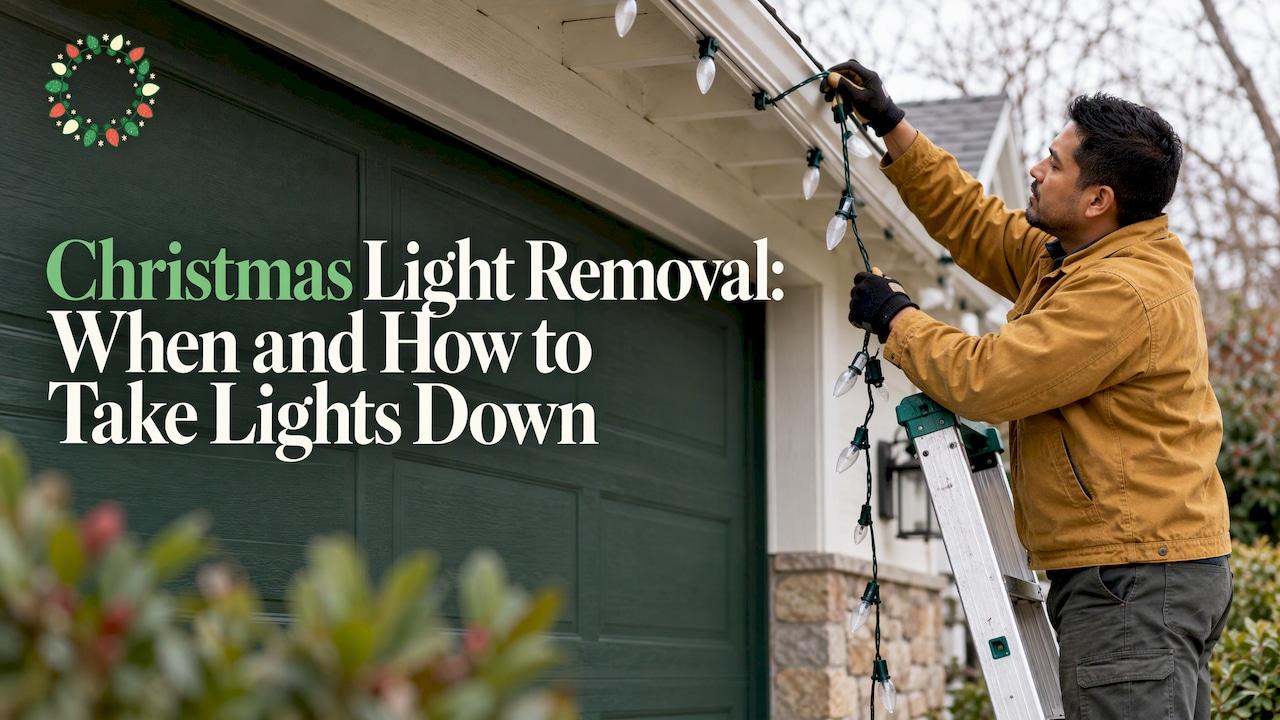
The best time to remove Christmas lights is after Christmas and, for most homes, before Three Kings Day on January 6 or by mid-January at the latest. The safest way is to have the crew that hung them take them down. In Sonoma and Napa counties, we design, install, maintain and remove custom-cut C9 LED displays as one service, so nobody on your staff or in your family climbs a ladder in January.
TL;DR
- Take lights down anytime after Christmas, ideally by January 6 and no later than mid-January in mild climates.
- Unplug first, never rip or yank lights, and open each clip instead of pulling the string.
- Most of the January risk comes from ladders and wet roofs, which is why many owners book takedown with the installation.
- Inspect each string as you pack it, and keep working sets dry and labeled by location.
- Broken light strings do not go in the recycling bin.
- Our service includes post-holiday takedown and storage, so removal is already handled.
Table of Contents
- When to take down outdoor Christmas lights
- Why removal is the riskier half of the job
- How to remove Christmas lights safely, step by step
- Inspect, pack and store the lights
- What to do with broken or unwanted lights
- Why takedown works best with the install
- Our approach to takedown
- Let us take them down for you
- FAQ
- Sources
When to take down outdoor Christmas lights
There is no legal holiday deadline, but there is a good window. Etiquette expert Diane Gottsman says lights can come down anytime after Christmas, preferably before Three Kings Day on January 6. Many homeowners choose New Year's weekend, when family is around to help and the weather is often dry.

There are practical reasons not to wait. Leaving lights up past January exposes them to weather cycles, stronger sun as days lengthen, and, in some neighborhoods, HOA notices. The same Family Handyman article refers to a National Electric Code rule that allows holiday lights to stay up 90 days at most. If you lit your home in mid-November, that clock ends in mid-February.
A simple timeline
| Situation | Good takedown window |
|---|---|
| Traditional household | December 26 to January 6 |
| Busy household or travel in early January | First two weeks of January |
| Cold, icy climate | By early February at the latest |
| Business with a seasonal brand | After New Year's, before the post-holiday sales lull ends |
| HOA or managed property | Check the community's rules; plan for early January |
Sonoma County winters are mild, but rain is the real issue. Roofs, gutters and ladders are slippery after a storm, so plan on a dry day and keep a backup date.
Why removal is the riskier half of the job
Decorating injuries are common. The Consumer Product Safety Commission has estimated about 250 holiday decorating injuries a day during the season and urges caution on any ladder. Takedown happens in cold, damp, short-daylight weeks, often by someone who is tired of the project and wants it finished.
Two hazards stand out:
- Falls. Gutter-line and roof-edge work is where ladders are used most. Our ladder safety guide covers placement and footing in detail.
- Damaged wiring. Ripping lights off can break bulbs and stress wiring, which creates a fire hazard when the set is reused.
How to remove Christmas lights safely, step by step
If you do it yourself, this is the routine. At each step we note where it goes wrong and what our crews take off your hands.
1. Pick the day and unplug everything
Choose a dry, mild day with daylight to spare. Unplug every string and extension cord before you touch a clip. When you disconnect, hold the plug's grip area. NFPA says never pull on the cord, because it can damage wire and insulation and raise shock and fire risk.
Where it goes wrong: working on lights that are still on a timer and could switch on mid-job.
2. Set up the ladder properly
Work with a helper holding the ladder, keep your belt buckle between the rails, and never lean out to reach another few feet. Move the ladder instead. Rooflines over second stories and steep pitches are the point where most owners should stop and call a professional.
Where it goes wrong: reaching sideways, wet footing, and ladders on soft ground after rain. Our fully insured crew does this work every day, which is the reason many customers hand off takedown entirely.
3. Open each clip, then lift it off
Do not tug the string. Take the light out of the clip first, then lift and rotate the clip off rather than pulling straight down. The same guidance suggests working on a mild day, roughly above 40 degrees. If a clip is frozen or stuck, stop and come back when it is warmer, because force can damage shingles.
Around shingles and trim, be gentle. If you notice lifted or cracked shingles while you are up there, a roofer's assessment is worth getting before the next rain, and this guide to when to repair or replace shingles explains what to look for.
Where it goes wrong: yanking clips off, which cracks them and scars shingles and fascia. Our lights are custom-cut and mounted to fit the property, so the takedown follows the same layout we installed.
4. Handle trees, shrubs and railings
Start at the plug end and unwind toward the tip. Do not pull strings that have grown into branches. Cut away vegetation only if you must, and never cut the wire. Wet or frozen strings are brittle, so wait for them to dry.

5. Lower the lights, do not drop them
Coil as you go, or place strings in a bucket or bag clipped to the ladder. Dropped strings bend sockets and crack bulbs.
6. Check the house
Walk the perimeter. Look for stray clips in gutters, nails or screws left in trim, and cords tucked behind downspouts. This is also a good moment to clear leaves and debris from the gutters, and we offer gutter cleaning as a bundled service for the same visit.
Inspect, pack and store the lights
How you pack in January decides whether next year starts with a clean unspool or an afternoon of untangling.
- Inspect as you wind. NFPA advises throwing out sets with loose connections, broken sockets, or cracked or bare wires.
- Wind on a spool. Wind lights backward around a piece of cardboard, starting at the non-plug end, so the plug comes out first next year.
- Or wrap by hand. Wirecutter suggests hand-wrapping and tying the middle with a twist tie or rubber band.
- Dry them first. Let everything air dry completely before packing to prevent mildew.
- Label by location. Mark each coil with where it was used, such as front porch or roofline.
- Store dry. Use stackable plastic bins, in a dry place away from children and pets.
If you already have a knot, our guide on untangling Christmas lights shows how to fix it and prevent it next year.
What to do with broken or unwanted lights
String lights do not belong in curbside recycling. Massachusetts' recycling guidance explains that they wrap around sorting machinery. Many communities offer special collection for string lights as e-waste or scrap metal, and if none exists, trash is the fallback. Some large retailers accept broken lights during the holiday season, though dates and acceptance vary by location, so check your local Sonoma or Napa County waste hauler's page first. Working sets can be donated.
Why takedown works best with the install
Holiday lighting is one project with two ends. The way lights are mounted determines how safely and cleanly they come off. A crew that cut the strands to the roofline, placed the clips and mapped the circuits knows exactly how to reverse it.
For a business the stakes are higher. A dealership, winery, hotel or shopping center cannot spend staff hours on ladders in January, and a half-lit storefront in February looks neglected. Property managers also need clear communication and little disruption to tenants. Booking removal with installation turns takedown from a loose end into a scheduled line item.
Our approach to takedown
Takedown is where a lighting job is judged. Anyone can hang lights in November with a fresh set and good weather. In January you find out whether the lights were fitted properly, whether the clips come off cleanly, and whether the roofline is left exactly as it was.
As a firefighter-owned crew, we take ladder work seriously. We are fully insured, and we handle design, installation, in-season maintenance, takedown and storage under one team. That means you do not hunt for someone in January, and you do not store tangled boxes in the garage.
Our custom-cut C9 LED lights are designed to fit each property, so removal is orderly rather than a scramble. If you want your holidays to start and end without a ladder, that is what we built the service for.
Allen
Let us take them down for you
Our residential installation packages include design, installation, in-season maintenance, takedown and storage. Pricing is published as from $1 per linear foot, Classic from $600, Signature from $1,500 and Custom Display from $4,000, all one-off. We also light commercial properties, estates and wineries across Santa Rosa, Windsor, Healdsburg, Petaluma, Rohnert Park, Napa and nearby towns.

If you want next January handled before the season begins, get in touch through our site and we will plan the whole cycle with you.
FAQ
Is it okay to leave Christmas lights up until February?
It is better not to. Lights left through winter face more weather and sun exposure, and some HOAs send notices. The electrical code reference cited by Family Handyman allows up to 90 days, so plan removal in January.
When should businesses take down holiday lights?
Most commercial properties remove them in the first half of January, after New Year's trade. Scheduling takedown with the installer avoids pulling staff onto ladders and keeps the storefront looking sharp.
Can I remove lights in the rain?
It is safer to wait. Wet roofs and ladders are slippery, and frozen or soaked clips and cords are easy to damage. Pick a dry, mild day and keep a backup date.
How do I store lights so they do not tangle?
Inspect each string, let it dry, then wrap it around cardboard from the non-plug end or hand-wrap it with a tie in the middle. Label the coil and keep it in a dry bin.
Sources
- When Should You Take Down Your Christmas Lights? (Family Handyman)
- Holiday Lighting Takedown
- CPSC holiday decorating injuries release
- NFPA: Christmas tree home fires in January
- Removing Christmas Light Clips Without Breaking Them
- How to Organize and Store Christmas Decorations (Wirecutter)
- How to Store Holiday Decor So It Lasts for Years
- Recycle Smart This Holiday Season (Mass.gov)
- How to Recycle Christmas Lights (Rumpke)