
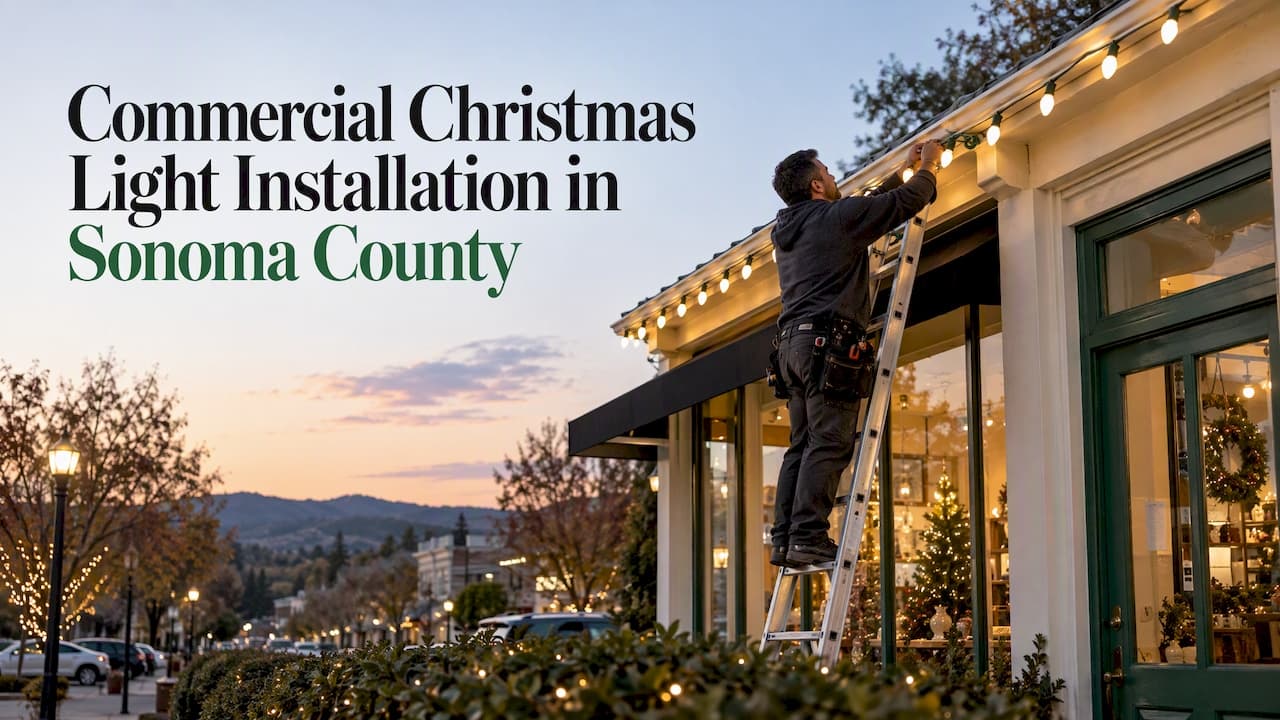
Commercial Christmas light installation is a done-for-you service. A professional crew designs the display for your building, hangs commercial-grade lights, keeps them working all season, then takes them down and stores them. You get a lit storefront, office, or property without sending staff up a ladder. At A Bright Service, we do this for businesses, property managers, estates, and wineries across Santa Rosa and Sonoma County. This guide covers what a full-service job includes, what drives the price, the safety rules that matter, and how to plan.
TL;DR
- A complete commercial program covers design, installation, in-season maintenance, takedown, and storage. Check that every piece is in your quote.
- Price depends on linear footage, building height, access equipment, design complexity, after-hours work, and service visits. Ask for a quote based on a site walk, not a guess.
- Holiday lighting is an OSHA fall-protection focus. Hire a fully insured crew that works to ladder and electrical safety standards.
- Start the conversation early in the fall so design, ordering, and scheduling are not squeezed into a few days.
- We are a firefighter-owned, fully insured local crew. Request a commercial quote to start.
Table of Contents
- What commercial holiday lighting installation includes
- How to plan a commercial holiday lighting project
- What affects the price of commercial Christmas lighting
- Safety, electrical, and compliance basics
- In-season maintenance: what good support looks like
- Takedown and storage
- How to choose a commercial installer
- Commercial lighting from A Bright Service
- A simple checklist for your first commercial season
- FAQ
- Sources
What commercial holiday lighting installation includes
A commercial job is different from a homeowner hanging a few strands. The lights run along rooflines, columns, windows, signs, trees, and sometimes parking areas. They have to look good at the standard of a business that customers judge at a glance.
A full-service scope usually has five parts:
- Design. A walk of the property to decide where lights go, which colors and effects fit your brand, and how power will be supplied.
- Installation. Custom-measured lights mounted securely with clips and hardware made for the surface, not staples or tape.
- Maintenance. Repairs during the season when a section goes dark, a bulb fails, or wind and weather cause damage.
- Takedown. Careful removal after the holidays, so nothing is left hanging on the building.
- Storage. Reusable components kept off your premises until next season.
That list matches how public buyers describe the work. A utility board's 2026 request for proposals for exterior Christmas lighting asks for design, installation, maintenance, removal, and storage where applicable. If one bidder quotes only installation, you are comparing two different products.
Who uses commercial lighting services
The service fits a wide range of properties:
- Retail storefronts and restaurants in downtown districts and shopping centers
- Office buildings and medical or professional parks
- Apartment communities and HOA common areas run by property managers
- Hotels, inns, and event venues
- Estates and wineries with long driveways, mature trees, and tasting rooms. We handle these through our estate lighting and winery holiday lighting services.
How to plan a commercial holiday lighting project
The biggest mistake we see is waiting until the week after Thanksgiving. By then, good installation dates are scarce and there is no time to adjust a design. A more comfortable timeline looks like this.
Late summer to early fall: decide and measure
Decide who owns the project. In a business that is often the owner or office manager. In a managed property, it is the property manager reporting to a board. Gather the basics: the address, which sides of the building face traffic, and any areas that need to stay clear, such as fire access, signage, or awnings.
Then book a site visit. A crew should measure the roofline and other areas on site. Photos help, but a walk reveals things photos hide: a steep pitch, a tree in the way, a missing outdoor outlet, or brittle trim.
Early fall: approve the design and the quote
Ask for a written proposal that shows the areas to be lit, the style of light, the number of service visits, and the removal and storage terms. This is also when you check approvals. Tenants, landlords, and HOA boards may each need to sign off on attaching anything to a building. A downtown business district or historic area may have its own guidelines, so ask your city or property owner before you commit.
Before the lights go up: power and access
Confirm where the display will plug in. Outdoor outlets should be reachable, working, and on a circuit that can carry the load. Our crew checks this on the walk-through. If a new outlet or timer is needed, it is better to learn that weeks ahead than on installation day.
Installation, season, and takedown
Once the lights are up, you should know who to call, how fast repairs happen, and when takedown is scheduled. Many businesses keep their lights on from late November through early January. Sort out the removal timing in advance so the display is not still up when the season is over.
What affects the price of commercial Christmas lighting
Commercial pricing is quoted per project because no two buildings are alike. A small storefront and a multi-building campus are different jobs. The factors that move the number are consistent:
- Linear footage. More roofline, trim, and perimeter to light means more product and more labor.
- Mounting height. One-story and three-story buildings need different access equipment and different crew time.
- Lifts and equipment. Tall or hard-to-reach areas may need specialized access gear rather than a ladder.
- Design complexity. Wrapped trees, columns, wreaths, and layered effects take more design and install time than a simple roofline.
- After-hours work. If the lights must go up when the business is closed, so customers are not disrupted, scheduling affects the quote.
- Maintenance visits. A program with scheduled in-season checks differs from install-only service.
- Takedown and storage. Removal, labeling, and keeping the lights stored are part of the full cost.
Our commercial service has no published price, because we quote after seeing the property. For a reference point on how we price, our residential program starts at $9 per linear foot, with packages from $600 (Classic), $1,500 (Signature), and $4,000 (Custom Display), all one-off. See the residential page for details. Commercial properties are usually larger and more complex, so expect a site-specific quote.
Rent, buy, or lease: what the quote should say
Some providers sell you the lights, and some supply and own them. This changes your costs in future years. Ask whether the lights are yours after the season, whether storage is included, and whether next year's reinstallation is a new quote or a renewal. Get these answers in writing.
Safety, electrical, and compliance basics
Hanging lights on a building means working at height, near power, in cold or wet weather. That is why safety belongs in the first conversation, not at the end.
Fall risk is the main hazard
OSHA treats holiday lighting as a real hazard. In its 2023 release, the Department of Labor urged employers to train workers to prevent serious injuries while hanging holiday lights, with ladders and roofs called out. OSHA's national emphasis program on falls also lists holiday light installation as a targeted activity.
For a business, this has a practical meaning. Having your own employee climb to hang lights puts a worker, and potentially your insurance, at risk. Hiring a trained, insured crew moves that risk to people whose job it is.

Ladders near power lines and roofs
OSHA's construction guidance says ladders need nonconductive side rails where a worker or the ladder could touch energized conductors. It also says portable ladders that are not self-supporting must extend at least 3 feet above the landing surface, or be fitted with grab rails. A good crew follows these rules as routine and can explain how it sets up on your building.
Extension cords and power strips
Commercial displays often fail on power, not on bulbs. Fire safety guidance from NFPA says power taps should not be daisy-chained, and extension cords should go into approved receptacles, power taps, or multiplug adapters, never into other extension cords. Ask your installer how the display is powered and how many runs share a circuit.
Temporary wiring has a time limit
Under OSHA's wiring standard, temporary electrical power and lighting for Christmas decorations may be used for no more than 90 days, and temporary wiring must come down promptly when its purpose ends. This is one more reason to schedule takedown at installation. A display that goes up in mid-November and comes down in early January sits well within the limit.
Permits and local rules
Requirements vary by city and property. Some landlords, HOAs, and business districts have rules on attachment methods, brightness, flashing effects, or timing. We suggest asking your property owner and city planning or building office before approving a large design. Our crew works across Santa Rosa, Windsor, Petaluma, Rohnert Park, Healdsburg, and Napa, and we are familiar with the property types in those communities.
In-season maintenance: what good support looks like
A lighting display is only as good as its worst dark section. A strand that fails on a busy December Saturday costs you the point of the investment.
A solid maintenance plan has these features:
- Scheduled inspections, so small issues are caught before customers see them
- A clear way to report an outage, with a stated response time
- Replacement of bulbs, strands, and clips as part of the program
- Repairs for weather damage after storms and wind
The public RFP mentioned above also asks for seasonal maintenance and repairs, plus cleanup, and compliance with OSHA and applicable safety requirements. Those are reasonable expectations for any commercial buyer. Ask each installer to spell out how many visits are included and what counts as a covered repair.
Takedown and storage
Takedown is where a sloppy provider shows. Lights pulled down in a hurry get tangled, damaged, or left behind on a gutter for months. A good takedown means the full display is removed, the property is left as it was, and reusable parts are labeled and stored.
When you review a quote, check:
- When takedown happens, and whether you can request a date
- Whether storage is included, and where the lights are kept
- Whether the crew notes damaged or missing parts at removal, which makes next year's plan easier
- Whether next season's reinstallation is simple to rebook
We handle takedown and storage as part of our service, so you do not need to find space for boxes of lights or deal with tangles in January.
Why we do it this way
We started A Bright Service because we saw how many holiday decorating jobs go wrong when the owner tries to do it alone: ladders on uneven ground, tangled lights, and half-lit rooflines. As a firefighter-owned crew, we take safety personally, and we think a business should not have to take on that risk for the sake of a nice storefront.
Our approach is all-in-one. We design for the property, custom-cut C9 LED lights to fit, mount them professionally, maintain them through the season, then take them down and store them. One team, one plan, one call if something goes dark.
We think that is the best way for a busy owner or property manager to get a display that looks sharp and stays that way. We are fully insured, and we are happy to walk your property and tell you honestly what it needs.
Allen
How to choose a commercial installer
Use these criteria when you compare proposals. They apply to any provider, and they are the questions we expect to answer ourselves.
| What to check | Why it matters |
|---|---|
| Insurance | Confirms coverage if someone is injured or property is damaged. Ask for a certificate. |
| Scope in writing | Design, install, maintenance, takedown, and storage should each be listed. |
| Site walk before quote | Measured, not estimated from a photo or address alone. |
| Light quality | Commercial-grade, custom-fit LED rather than consumer strands. |
| Safety practices | Ladder setup, fall protection, and electrical approach explained plainly. |
| Maintenance terms | Response time and number of visits during the season. |
| Removal date | A set takedown window, well inside the 90-day limit for temporary wiring. |
| Local experience | Knows your city, property types, and any local guidelines. |
If a proposal is much cheaper than the others, compare scope before you compare price. The gap often comes from missing maintenance, missing storage, or a plan to skip equipment that safe work needs.
Commercial lighting from A Bright Service
We provide commercial Christmas light installation for businesses, offices, and managed properties across Sonoma County. Every project includes design, custom-cut C9 LED lights, professional mounting, in-season maintenance, takedown, and storage. If your building has gutters that need attention before the lights go up, we also offer gutter cleaning as a bundled service.

To get a quote, see our commercial holiday lighting page or contact us through our main site. Local business owners can also look at our pages for Santa Rosa, Healdsburg, and Petaluma.
A simple checklist for your first commercial season
If this is your first time hiring a service, run through these steps:
- Name one person who owns the project and approves the quote.
- Check with your landlord, HOA, or city about any rules for attaching lights or running a display.
- Walk the property with a crew and agree on which areas are lit.
- Confirm power: working outdoor outlets, circuit capacity, and timers.
- Get the scope in writing: design, installation, maintenance, takedown, and storage.
- Ask for proof of insurance.
- Set the on and off dates, and the takedown window.
- Save the maintenance contact number where your staff can find it.
This takes an hour or two of your time. The crew handles the rest.
FAQ
When should a business book commercial Christmas light installation?
In our experience, the best time to start is early in the fall, well before Thanksgiving. That leaves room for a site walk, a design, a written quote, and any approvals from a landlord or HOA. Booking late can limit your choice of installation dates.
Is commercial installation a one-time cost or a recurring one?
It depends on the program. A service that includes custom installation, maintenance, takedown, and storage is typically a seasonal service you renew each year. Ask your installer whether lights are stored for reuse and how next year's reinstallation is priced.
Do commercial properties need permits for holiday lights?
Requirements vary by city, landlord, and property type. Many displays need no formal permit, but a landlord, HOA, or business district may have its own rules. Check with your property owner and your city's building or planning office, and ask your installer what they have seen locally.
What happens if part of the display goes dark?
With an in-season maintenance plan, you report the outage and the crew comes to repair it. Ask for the response time and number of visits in your proposal. We include maintenance through the season so a failed section does not stay dark.
Why not have our own staff hang the lights?
Hanging lights means ladder and roof work, which OSHA flags as a fall hazard. A trained and insured crew carries the equipment, experience, and coverage for the job, and your staff can focus on running the business.
Sources
- Harriman Utility Board request for proposals, exterior Christmas lighting (2026)
- U.S. Department of Labor news release on holiday light safety (2023)
- OSHA CPL 03-00-025, National Emphasis Program on Falls
- OSHA Construction Industry Digest
- NFPA, electrical and fire safety considerations
- OSHA 29 CFR 1910.305, wiring methods, components, and equipment