
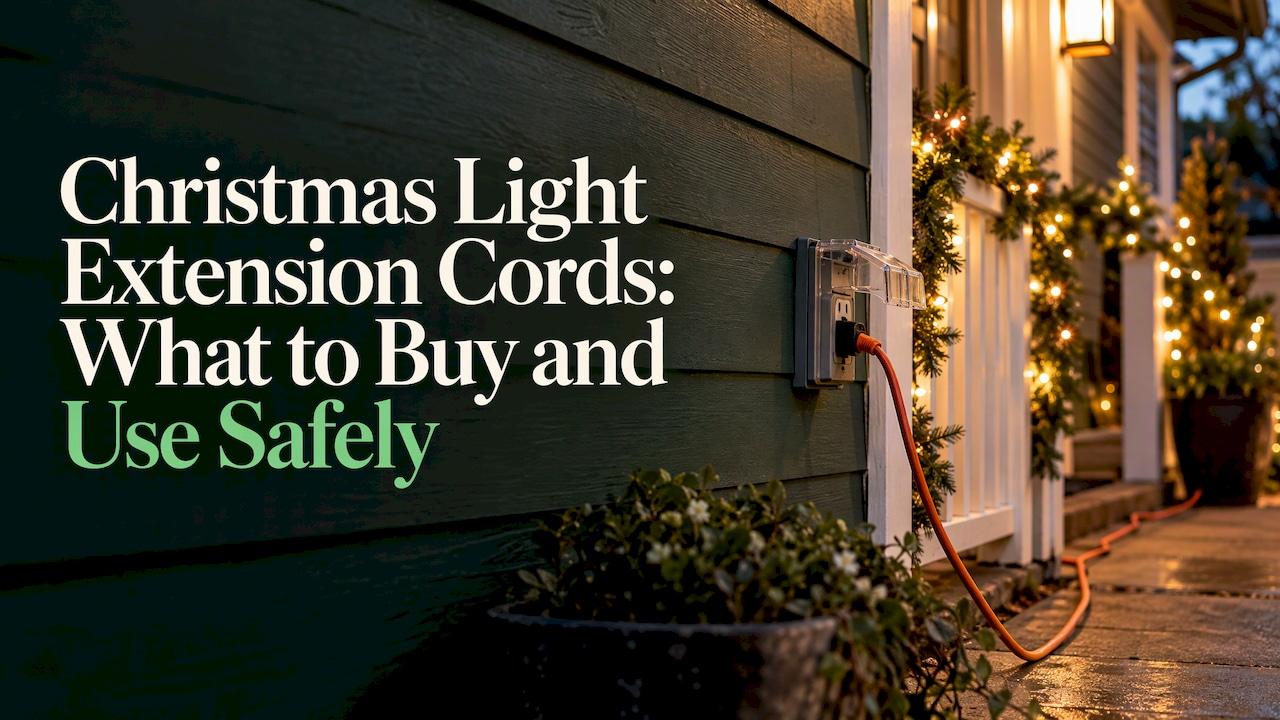
For outdoor Christmas lights, use a three-prong extension cord marked for outdoor use (look for a "W" on the jacket), plug it into a GFCI-protected outdoor outlet, keep every connection dry and off the ground, and never daisy-chain cords together. Get those four things right and most of the real risk is gone. At A Bright Service Christmas Lights, we design and install holiday lighting for homes and businesses across Sonoma and Napa counties, so the cords, outlets and connections behind a display are part of how we think about a safe job.
TL;DR
- Use only cords rated for outdoor use, with three prongs and a "W" marking. Indoor cords never belong outside.
- Plug into a GFCI-protected outlet with a weatherproof in-use cover, or add a portable outdoor GFCI.
- Keep cords to three standard sets of lights each, never chain cords together, and match amps to the cord's rating.
- Keep connections off the ground and sealed against moisture, and inspect every cord before you use it.
- Temporary holiday wiring is meant to come down within 90 days, and a professional install takes the ladder and cord work off your plate.
Table of Contents
- Which extension cord is right for outdoor Christmas lights
- Gauge and length: why a longer cord needs thicker wire
- How many strands can share one extension cord
- Plugging into an outdoor outlet: GFCI first
- Keeping connections dry and cords undamaged
- The 90-day rule and when to take lights down
- What a professional job changes about cords
- Our perspective
- Get the display without the cord work
- FAQ
- Sources
Which extension cord is right for outdoor Christmas lights
The Texas State Fire Marshal's Office says to use extension cords with a three-prong plug approved for outdoor use by an organization such as Underwriters Laboratories, and never to use indoor cords outside. The Electrical Safety Foundation International (ESFI), a nonprofit that publishes electrical safety guidance, adds that cords and decorations used outdoors should be marked for outdoor use and that the amperage the lights draw should be matched to the cord's amperage rating.
That gives you a short buying checklist:
- Outdoor rating. The jacket should carry a "W" and a listing mark such as UL. A cord that says "indoor use only" is out.
- Three-wire grounded plug. Two-prong cords are for indoor lamps, not for a roofline.
- Hard-usage jacket. The University of Texas at Austin's environmental health and safety office explains that flexible cords should be rated for hard or extra-hard usage, with markings such as S, ST, SO and STO printed along the cord roughly every foot.
- The right gauge for the run. More on that below.
- Brightly visible color. Green blends into shrubs and brown disappears against brick, which is why decorators match cord color to the surface. That is a cosmetic choice. The rating is the safety choice.
A note for commercial buyers: the New York Electrical Inspection Agency explains that under the National Electrical Code (NEC), the model code most U.S. jurisdictions adopt, cords used for holiday lights must be listed for hard or extra-hard usage, and cords with the "PD" type label are not permitted. If you manage a storefront, dealership or shopping center, this is the rule an inspector or insurer will care about.
Gauge and length: why a longer cord needs thicker wire
The number on a cord is its wire gauge, and a lower number means thicker wire. Thin wire over a long distance heats up and loses power. The University of Texas factsheet gives a practical guide: a 16-gauge light-duty cord handles Christmas lights at 1 to 13 amps up to 50 feet and 1 to 10 amps at 100 feet, while a 150-foot run at 1 to 7 amps calls for 14-gauge.
Here is what that means in a typical yard:
| Run length | Cord gauge to look for | Amps the guide covers |
|---|---|---|
| Up to 50 feet | 16-gauge | 1 to 13 amps |
| Up to 100 feet | 16-gauge | 1 to 10 amps |
| 150 feet | 14-gauge | 1 to 7 amps |
Source for the table: the University of Texas at Austin extension cord factsheet linked above.
If you are unsure, buy the shortest cord that reaches and choose the thicker gauge. A coiled-up 100-foot cord powering a 10-foot run is a bad idea, because the extra length adds resistance and gets in the way.
A worked example
Say you have a 40-foot front roofline and a 6-foot wreath, and an outlet by the garage. LED strings draw very little power compared with old incandescent strings, so your total load is likely small. Check the wattage or amps printed on each set's tag, add them up, and compare the total to the cord's label. If the cord is rated for more than your total, with room to spare, you are fine. If you cannot find the figure on the tags, treat that as a reason to simplify the layout, not to guess.
How many strands can share one extension cord
Two official sources give a rule of thumb. The Texas State Fire Marshal's Office says to use no more than three standard-size sets of lights per single extension cord. ESFI says never to connect more than three strands of incandescent lights together, and warns that overloaded outlets can overheat and cause a fire.
The National Park Service gives a similar figure: no more than three mini-light strands or 50 screw-in bulbs linked together. Manufacturers print their own limit on the tag or box for each set, and that printed number wins over any rule of thumb, especially with LEDs, where longer runs are often allowed.
The bigger point is that the limit is on the whole chain, not only the cord. Count everything that ends up on one outlet: lights, inflatables, a motorized display, a pump for a fountain.
Plugging into an outdoor outlet: GFCI first
A ground fault circuit interrupter (GFCI) cuts power in a fraction of a second when electricity leaks to the wrong path, such as through water or a person. Every outdoor source of power for holiday lights should have one.
- Dean Austin, a senior electrical specialist at the National Fire Protection Association (NFPA), says GFCI protection of the circuit or receptacles is crucial for exterior holiday lighting.
- ESFI says that if your outdoor circuits are not GFCI-protected, portable outdoor GFCIs are sold where electrical supplies are sold and need no special knowledge to install.
- The New York Electrical Inspection Agency notes that receptacles that are not part of a building's permanent wiring, which includes extension cords, must be GFCI protected, and that listed portable GFCI cords are permitted.
Test the GFCI outlet's button before you plug anything in. If the outlet trips every time it rains, moisture is getting into the cover or the cord connection. An electrical contractor quoted by This Old House notes that a GFCI breaker at the indoor panel can avoid false trips from moisture. That is a job for a licensed electrician.
The in-use cover matters as much as the outlet
A standard flip cover only protects the outlet when nothing is plugged in. With a cord plugged in, you need an expandable weatherproof in-use cover that closes around the cord. This Old House shows that cover paired with cord-protect covers over each cord-to-cord connection so moisture stays out.
If you have no outdoor outlet at all, do not run a cord through a cracked window or door for the season. Clark County, Nevada's fire department says to limit extension cords to temporary uses rather than a permanent power source. A Minnesota electrical contractor puts it practically: if you need power 20 feet from the house, the right answer is a properly installed outlet, not a permanent cord. A licensed electrician can add one.
Keeping connections dry and cords undamaged
Most cord trouble comes from three places: the connection point, the cord's path and the cord's condition.
The connection point. The Texas fire marshal advises waterproofing all connections and keeping them elevated so rain does not drain into them. Utah State University Extension says to keep connections above the ground and out of snow and water. In Sonoma County's wet winters, that means a hook, a stake or a hanging loop rather than a plug sitting in a puddle on the lawn.
The path. Do not run cords under rugs or across doorways, and do not pinch them in a door or window. ESFI warns against pinching cords in doors, windows or under heavy furniture. Where a cord has to cross a walkway, Utah State recommends taping it down to avoid a trip.
The condition. The University of Texas factsheet warns that frayed or damaged cords should not be used and electrical tape is not a fix. The South Carolina fire safety guidance adds not to plug extension cords into one another and to replace worn or broken cords. If you need more reach, buy one correctly rated, longer cord instead of joining two.
NFPA also recommends a visual inspection of lights, wires and extension cords each year. Look for cracked insulation, bent or loose prongs, scorch marks and warm plugs. Anything suspect goes in the trash.

Add a timer
An outdoor-rated stake timer or plug-in timer switches your display on and off automatically. This Old House includes one in its outdoor setup, and it means lights are not running all night when no one is looking at them.
The 90-day rule and when to take lights down
Holiday lights are treated as temporary wiring. NFPA notes that the 2026 NEC permits temporary holiday decorative lighting for no more than 90 days. Count from the day you plug in, not from Thanksgiving. If you hang lights in mid-November, you have until mid-February at most, and that is a ceiling, not a target.
If you take lights and cords down yourself, coil them loosely, keep them dry and store cords separately from lights so nothing gets crushed. Our guide to when and how to take Christmas lights down covers the timing, and the thinking behind storing holiday decor between seasons applies to cords too: protect them from crushing and moisture, and they will be ready next year.

What a professional job changes about cords
The cord rules above are not hard, but they pile up: gauge, rating, load, GFCI, in-use cover, drip loops, timers, inspection, takedown. And all of it happens on a ladder, in the cold, in the rain season. ESFI's president has noted that decorations account for one in four holiday fires, and the common thread is ordinary overloads and wet or damaged connections.
Our approach is built to take that work off your hands. We offer custom-cut C9 LED lighting, so each installation fits your property rather than being stretched or bundled from stock lengths. Design, installation, in-season maintenance, takedown and storage are all part of the service, handled by a fully insured, firefighter-owned crew. If you want to understand the lights themselves, start with our explainers on custom-cut Christmas lights and what C9 lights are. For the ladder side of the job, see our ladder safety guide, and for the wider picture, our piece on Christmas light fire hazards.
For businesses: cords, outlets and guest experience
Hotels, wineries, restaurants, dealerships and shopping centers have more to think about than a house does: more outlets, longer runs, foot traffic and tenants. A storefront with a cord across the entrance is both a hazard and a bad first impression. If you are planning a larger scheme, this overview of commercial lighting design basics helps frame the questions to ask, and our page on commercial Christmas light installation in Sonoma County explains how we approach it so no work lands on your staff.
Our perspective
Every year, people tell us the same thing: they planned to do it themselves, and then the ladder came out, the cord was two feet too short and the outlet kept tripping. The lights are the fun part. Everything behind the lights is what takes the weekend.
We came to this work with a safety mindset, and a firefighter-owned crew sees why the details matter. A display should be something your family or your guests enjoy for the season, not something you check nervously from the window.
That is why we handle design, installation, maintenance through the season, takedown and storage as one service, with custom-cut C9 LED lights fit to your property. You get the glow without the ladder, the tangles or the cord math.
Allen
Get the display without the cord work
If you would rather not size cords, test outlets and climb a ladder, we can handle the whole job. Our residential packages start with Classic from $600, Signature from $1,500 and Custom Display from $4,000, and installation is also available from $1 per linear foot. Commercial, estate and winery projects are quoted individually, and we also offer gutter cleaning that can be bundled with a lighting install.

See residential Christmas light installation for the packages, or visit A Bright Service Christmas Lights to request a quote for your home, storefront, estate or winery in Santa Rosa, Windsor, Healdsburg, Napa and across Sonoma County.
FAQ
Can I use an indoor extension cord for outdoor Christmas lights?
No. The Texas State Fire Marshal's Office says to never use indoor cords outside. Outdoor cords have jackets made to handle moisture and temperature swings, and they carry a "W" marking along with a listing such as UL.
Do Christmas lights run up your electric bill?
They add to it, but how much depends on the type of lights and how many hours they run. LEDs draw far less power than old incandescent strings. Put the display on a timer so it only runs during the hours people will see it.
What can I use instead of an extension cord?
A permanently installed outdoor outlet is the right answer when you need power in a spot your cords keep having to reach. Code guidance treats extension cords as a temporary solution only, so a licensed electrician should add the outlet. Plan the lights around where power exists.
How do I plug in lights on a house with no outdoor outlet?
Have a licensed electrician install a GFCI-protected outdoor outlet with a weatherproof in-use cover. Do not run a cord through a window or door for weeks, because it can be pinched and damaged. Until the outlet is in, use battery-powered lights that are rated for outdoor use.
How long can holiday lights stay up?
Temporary holiday lighting is limited to 90 days under the NEC, as NFPA notes. Plan your takedown so cords, timers and lights come down well before that limit and are stored clean and dry.
Sources
- How to Safely Hang Outdoor Christmas Lights, This Old House
- Electrical Safety Tips for Using Exterior Holiday Lights, NFPA
- Outdoor Decoration Safety Tips, ESFI
- Avoid Serious Electrical and Fire Hazards Decorating Your Home, ESFI
- Decorating Safely with Lights, Texas State Fire Marshal's Office
- Factsheet: Extension Cords, University of Texas at Austin EHS
- Requirements for Temporary Holiday Lights, New York Electrical Inspection Agency
- Outdoor Outlets and Landscape Lighting, MN Code Guide
- Fire Prevention 52: Deck the Halls Safely, National Park Service
- Holiday Lights and Decorations, Clark County, NV
- Festoon Your House Safely, Utah State University Extension
- Outdoor Holiday Decor Safety, South Carolina Fire Marshal