
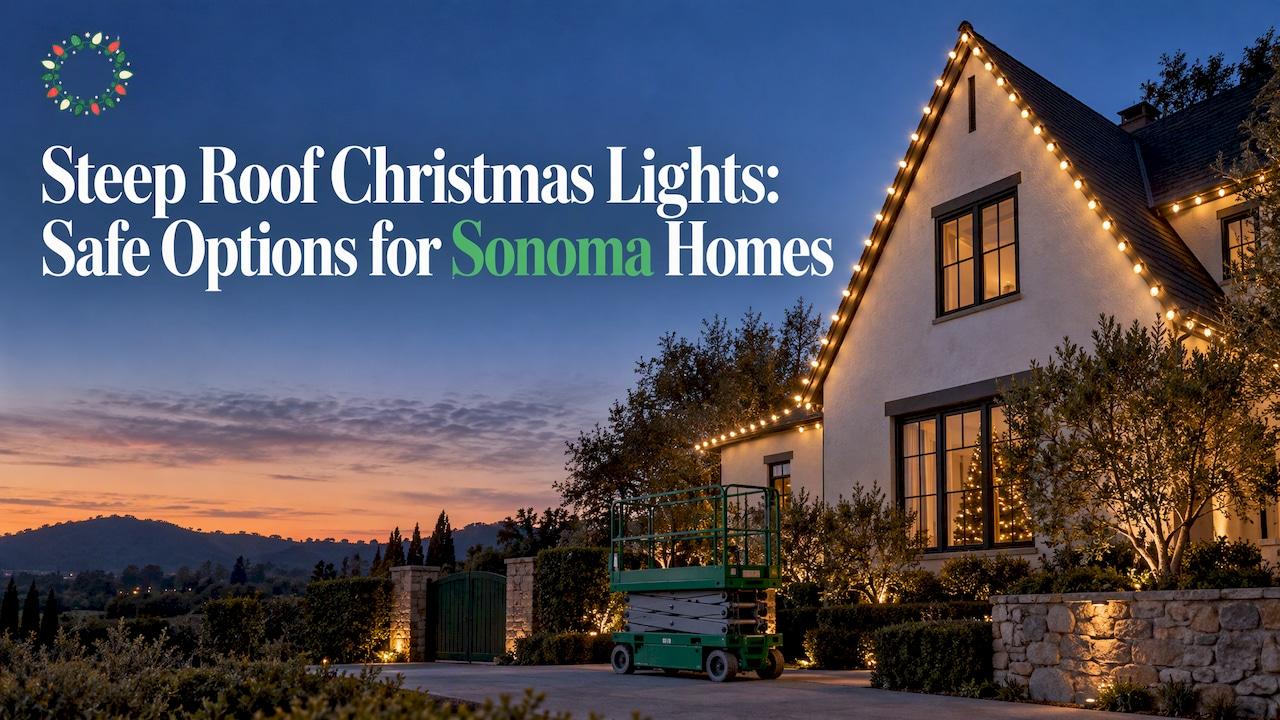
The safest way to light a steep roof is to keep your feet off it, and on a steep or tall roofline that usually means handing the job to a crew built for it. Pitch, height, cold shingles and gutters that were never meant to carry a ladder all stack the odds against a weekend project. We are A Bright Service, a firefighter-owned, fully insured crew in Sonoma County, and our residential installation covers design, custom-cut C9 LED lights, mounting, in-season maintenance, takedown and storage, so nobody in your household climbs anything.
TL;DR
- Steep pitches, two-story rooflines, brittle cold shingles and loose gutters are the situations roofers themselves say to hand to a professional.
- Staples, nails and screws through shingles can cause leaks. Lights belong on clips made for the surface, and a pro plans that before the first strand goes up.
- Ladder rules (a 4-to-1 setup, a stable base, never leaning on the gutter) matter most on the tall, awkward edges steep roofs have.
- Power lines, GFCI outlets and outdoor-rated cords are part of the job, not an afterthought.
- Our published residential packages start at $600, so you can compare the cost of a professional install with the risk of doing it yourself.
Table of Contents
- Why a steep roof changes the whole job
- What the ladder rules ask for
- Cold shingles, staples and what a roof can take
- Electrical safety up high
- When to hand the job off
- What our crew takes off your hands
- What it costs
- Get a steep roofline lit without the climb
- Our perspective
- FAQ
- Sources
Why a steep roof changes the whole job
A low, simple ranch roofline can be lit from a ladder by a careful person. A steep roof is different because every task gets harder at once. Reaching the eave means a taller ladder. Gables and dormers sit above surfaces you cannot stand on. A mistake does not mean a dropped strand; it means a fall.
Roofers who write for homeowners say the same thing. One roofing company advises that if the work means walking on the roof, reaching over an edge or working on a steep slope, hiring a qualified professional with the right equipment and training is generally safer. Another lists the situations where it recommends a pro: a steep or multi-story roof, hard-to-reach peaks or dormers, fragile tile, a slippery or uneven surface, existing roof damage or unstable gutters.
Pitch is written as rise over run. A 6:12 roof rises 6 inches for every 12 inches of horizontal distance. Many roofing guides treat 6:12 or steeper as a pitch that needs extra precautions. Plenty of Sonoma and Napa homes go well beyond that: custom estates with multiple gables, hillside houses with a tall downhill side, and wine-country farmhouses with steep dormers.

Height you do not see from the driveway
A hillside lot can make a one-story front a three-story back. The roofline you are lighting may be far taller than the one you see when you pull in. That is also where ladders are hardest to set on level ground, which brings us to the ladder itself.
What the ladder rules ask for
Most people who hang lights use a ladder, and ladder rules are specific. Oregon OSHA's portable ladder guide says a non-self-supporting ladder should be set at a 75.5-degree angle, a 4-to-1 ratio of working length to set-back distance. When the top rests on an eave or other projecting surface, the set-back is measured from directly below that support point, not from the recessed wall. On a house with deep eaves, that changes where the feet go and how long the ladder must be.
Two more points come up on steep roofs:
- The gutter is not a support. Safety guidance warns that gutters can bend, pull away from the fascia or let the ladder slide. A standoff that spans the gutter and bears on the roof or wall, plus a tied-off top, is the safer setup.
- A helper does not fix a bad position. One person steadying the ladder helps, but a helper does not make an unsafe ladder position safe. The ladder gets repositioned, not leaned sideways.
When a ladder is used to step onto a roof, OSHA's rules call for the side rails to extend at least 3 feet above the upper landing. If you want a deeper walk-through of why these rules exist, our own guide to ladder safety for Christmas lights covers it, and our piece on holiday lights for hard-to-reach areas explains how we approach difficult spots.
Professional crews also have options a household does not. Work at height can be done from a stable platform instead of the roof itself, which is why equipment such as electric scissor lifts is common wherever people work above ground level. The point is the same: the less time a person spends balancing on a slope, the better.
Cold shingles, staples and what a roof can take
Steep roofs in Sonoma County are rarely frozen, but cool mornings in December are normal, and cold changes how roofing behaves. One shingle maker's guidance, as relayed by a roofing company, says standard asphalt shingles become brittle and prone to breakage as temperatures approach freezing. A footprint or a lifted tab can crack one. Another roofer notes that a sealed shingle forced up on a cold day may not re-bond until it gets enough warm sun.
That is one more reason steep roofs are not friendly to casual walking: you risk damaging the roof you are trying to decorate.
Why fasteners matter
Staples and nails are the classic mistake. A roofing manufacturer's product manager says any penetration through roofing material with nails, screws or staples can lead to damaging leaks, and one staple misfire can ruin a whole strand. The same company recommends plastic clips made for asphalt roofs and gutters that come off cleanly in January. A staple through the face of a shingle opens a hole in the part of the roof that sheds water, and pulling the staple out does not close the hole.
Clip choice also depends on the surface. A clip guide maps them this way: gutter clips for gutter lips, shingle tabs for shingle edges, adhesive or masonry clips for brick and stucco, and magnetic clips only for ferrous steel. Aluminum gutters and standing-seam panels are not ferrous, so magnets slide off them. Wine-country homes often mix several of these surfaces on one house: composition shingle on the main roof, metal on a porch, stucco or stone below.

Spacing and straight lines
A straight line on a steep roof is hard to judge from a ladder at an angle. Spacing guidance for large bulbs like C7 and C9 is roughly one clip per bulb, about every 12 inches, with extra clips at corners and changes of direction. Our lights are custom-cut C9 LEDs, measured to your roofline so the bulb spacing lands cleanly at corners and peaks instead of ending in a leftover foot of cord. If you are curious about the bulb itself, here is what C9 Christmas lights are.
Electrical safety up high
The electrical side is easy to overlook when you are focused on the ladder. Three points matter.
- Power lines. OSHA requires an unqualified worker in an elevated position to stay at least 10 feet from unguarded energized lines of 50 kV or less. If any ladder, person or decoration would come near a service drop, stop and call the utility.
- Nonconductive ladders near energized parts. OSHA requires nonconductive side rails such as fiberglass wherever a worker or ladder could contact energized parts.
- Outdoor-rated gear and GFCI outlets. Electrical safety guidance recommends outdoor-rated lights and cords and GFCI-protected outlets. A GFCI interrupts power on a ground fault but does not make a damaged cord or wet connection safe.
Temporary lighting also has a time frame. OSHA's wiring rule allows temporary installations of 600 volts or less for Christmas decorative lighting for a period not to exceed 90 days. That is a practical reason to schedule takedown instead of leaving lights up into spring. Older homes deserve extra thought: if your house has knob-and-tube or aluminum wiring, have an electrician look at the circuit before adding a big display. For cords and loads, see our guide to Christmas light extension cords and our overview of the Christmas light fire hazard.
When to hand the job off
Pulling the advice together, these situations point to a professional:
- A roof you would have to walk on to reach the eave, peak or dormer.
- A roofline above one story, or a house that is taller on its downhill side.
- Gutters that are loose, sagging or pulling from the fascia.
- Fragile or brittle roofing, or any existing roof damage.
- Work near power lines.
- Any strand that needs a second person on the ground and a third in the air.
If two or more of those describe your house, the question is no longer whether you can do it. It is whether a one-evening project is worth that exposure. A roofing company's guide says it plainly: if you would have to be on the roof, hire a professional.
Businesses face the same math at larger scale. A dealership with a tall steep-pitched showroom roof, a winery tasting room with gables, or a shopping center with multiple rooflines cannot send staff up a ladder, and it should not want to. Our commercial, winery and estate services exist so that design, installation, maintenance, removal and storage stay off your team's plate.
What our crew takes off your hands
Here is how that looks on a steep-roof home. We are fully insured and firefighter-owned, and our approach covers the whole season, not just the install day.
- Design for your roofline. Each property gets a tailored layout, with custom-cut C9 LED lights fitted to the lengths your house actually has.
- Professional mounting. Our crew does the ladder and roofline work, so you do not climb, set a ladder on a slope or reach over an edge.
- In-season maintenance. If a strand goes dark in December, we handle it. See also how we think about repair in Sonoma.
- Careful takedown and storage. Lights come down after the holidays and are stored, so there is no January ladder trip and no tangled boxes in the garage. Here is more on when and how lights come down.
- Gutter cleaning, bundled if you like. Gutters carry weight and hold clips on many homes, and we offer gutter cleaning as an add-on service for the same visit.
We serve Santa Rosa, Windsor, Rohnert Park, Healdsburg, Glen Ellen and Napa, among other Sonoma and Napa County communities. For more on how we work locally, read about installation and maintenance in Santa Rosa or our home installation service.
What it costs
Our residential prices as published on our site start at $1 per linear foot, which gives you a way to estimate your own roofline. Packages are:
| Package | Published price |
|---|---|
| Classic | from $600 |
| Signature | from $1,500 |
| Custom Display | from $4,000 |
Commercial, estate, winery and gutter cleaning work is quoted per property, so there is no published price for those. For scale, one industry guide notes that professionals typically charge by the linear foot and that full displays run from a few hundred to several thousand dollars. Weigh that against what a fall, a cracked shingle row or a leak repair would cost, before you count your own weekend.
Get a steep roofline lit without the climb
If your roof is steep, tall or tricky, the simplest next step is to let us design it, hang it, maintain it and take it down. Pick a package on our residential installation page, or reach out through abrightservice.com for a commercial, estate or winery property.

Our perspective
We started this business because we have seen what happens when ladders, ice and good intentions meet. As a firefighter-owned crew, we think about the fall before we think about the bow.
A steep roof is where our approach pays off most. Design comes first: we look at your roofline, your gutters and your entry points, then cut the C9 LED runs to fit. Installation, in-season maintenance, takedown and storage are all ours, so the lights that go up on your house are the lights that come down, tidy, and ready for next year.
Homeowners tell us they want the glow without the Saturday on a ladder. Business owners tell us they want a welcoming storefront with nothing added to their staff's list. Both are fair, and both are why we offer the whole season as one service.
Allen
FAQ
Can I walk on a steep roof to hang lights?
Roofing professionals advise against it. Steep pitches call for extra precautions, shingles can crack when brittle, and a slope leaves little room for error. The safer approach is to work from stable, secured access or to hire a crew with the training and equipment, which is what we do.
Can you staple Christmas lights to a roof?
No. Nails, screws and staples can puncture shingles and create a path for water, and a staple can also damage the wire. Roofing manufacturers recommend plastic clips made for the surface instead, which come off cleanly after the season.
Is it safe to lean a ladder on the gutter?
It is not. Gutters can bend or pull away from the fascia, and the ladder can slide. A stabilizer that spans the gutter and rests on the roof or wall, with the top tied off, is the safer setup, and the base should follow the 4-to-1 rule.
How long can Christmas lights stay up?
OSHA's rule for temporary Christmas decorative lighting allows up to 90 days. Our service includes takedown and storage after the holidays, so the lights come down on schedule.
Sources
- Portable ladders: How to use them so they won't let you down (Oregon OSHA)
- 29 CFR 1910.305, Wiring methods, components, and equipment (OSHA)
- Christmas Light Install Safety: Ladders & Roofs (SafeBrief)
- How to Attach Christmas Lights to a Roofline Safely (Ameri Stain Roofing)
- How to hang Christmas lights on a roof? (Georgia Roof Advisors)
- How to Hang Holiday Lights Without Damaging Your Roof (Greenlee Roofing)
- How to Hang Christmas Lights on a Steep Roof Safely (Frontier Foam)
- The Dos and Don'ts of Hanging Christmas Lights (CertainTeed)
- Christmas Lights on Your Roof: Hang Them Without Damage (R&E Roofing)
- Christmas Lights on Roof: Hang Them Without Shingle Damage (Gerken Roofing)
- Christmas Light Clips for Shingles and Gutters (The Roofing Brief)
- How to Hang Christmas Lights on a House: Roof, Gutters (HomeProjectResources)
- Roofline Christmas Light Safety Basics And DIY Guide
- Electric Scissor Lifts: Types, Batteries, Tires and How to Choose (TrueBrady Co)