
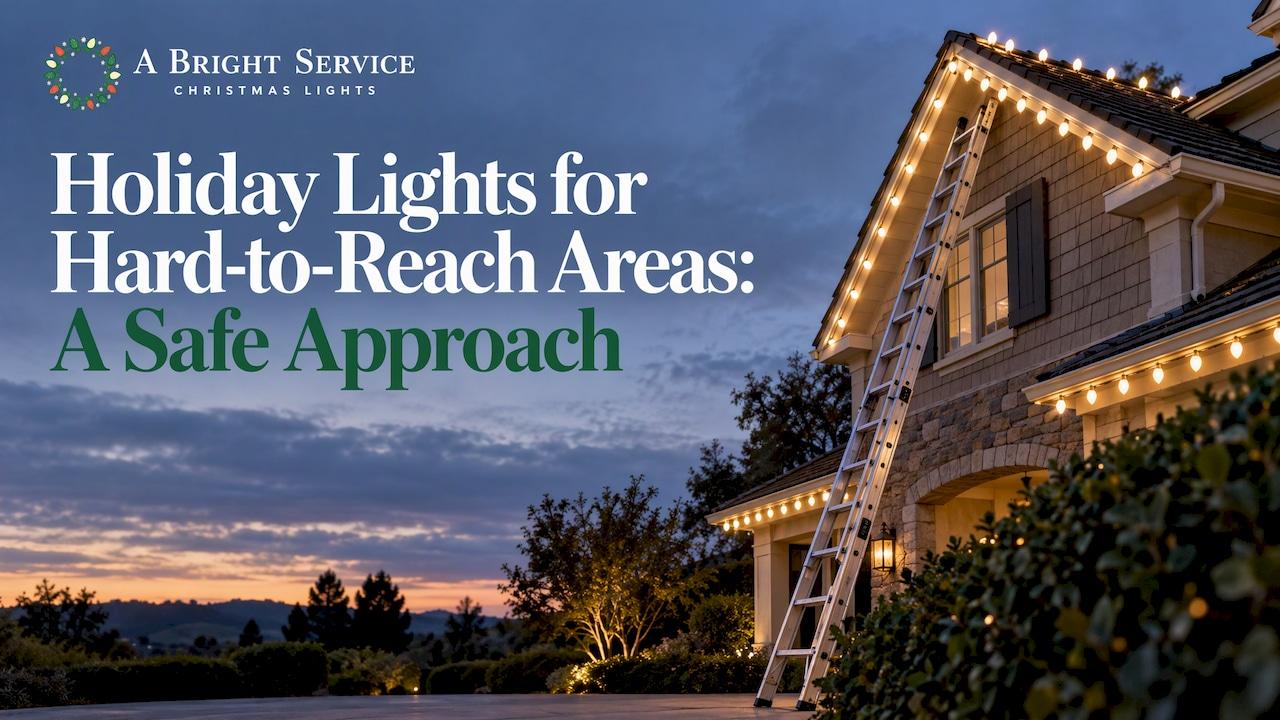
The hardest spots to light, such as steep roofs, tall peaks, second-story eaves and rooflines above porches, are also where most holiday decorating injuries happen. The safest way to light them is to hand the climbing to a professional crew that is insured, trained for roof work and equipped for the height. In Sonoma and Napa counties, that is what we do at A Bright Service: we design, install, maintain and take down your lights, so you enjoy the glow from the ground.
This guide explains what makes an area hard to reach, what safety groups say about working at height, what the electrical side demands, and how to plan a display that looks balanced from the street.
TL;DR
- A roof that is steep, fragile, icy, or simply high is a job for a professional installer, not a weekend ladder project.
- Fire departments report injuries from hanging lights every year, and they advise considering a qualified professional, especially for roof work.
- OSHA lists holiday light installation among the activities it targets for fall-hazard inspections, which shows how seriously falls are treated.
- Hard-to-reach areas also need outdoor-rated power, weatherproof connections and a plan for takedown, which is more than most people want to manage.
- Our crew handles design, installation, in-season maintenance, takedown and storage across Sonoma and Napa counties.
Table of Contents
- What makes an area hard to reach
- Why height is the real risk
- Power and weatherproofing matter more up high
- Why C9 LEDs suit tall and distant spots
- Planning a display that looks balanced from the street
- What different properties need
- The part people forget: maintenance, takedown and storage
- Perspective
- Let us light the high spots for you
- FAQ
- Sources
What makes an area hard to reach
Not every roofline is a problem. A single-story eave you can see from the driveway is one thing. These are different:
- Steep or fragile roofs. Steep pitches, older tile or brittle shingles, and icy or wet surfaces leave nowhere safe to stand. Roofing contractors note that when a roof is steep, fragile, icy or difficult to access, a professional installer may be the safer option.
- Second-story and higher rooflines. Gables, dormers and peaks above a porch roof or sloped yard put the ladder on uneven ground.
- Tall trees. Oaks, redwoods and ornamental trees common around Sonoma County properties often have the best canopy for a display and the worst access.
- Commercial façades. Storefronts, dealership showrooms, shopping center parapets and winery tasting room buildings are tall, wide and often surrounded by parking, customers and traffic.
- Areas near power lines. A service drop or street line near the roofline changes the whole job.
If you can name one of these on your property, you already know where the display would look best. That is no coincidence: lights placed high carry farthest, so the hard spots are often the ones you most want lit.
Why height is the real risk
The National Electrical Safety group ESFI, the Electrical Safety Foundation International, advises using wooden or fiberglass ladders, extending a ladder at least three feet past the roof edge, and keeping yourself and your equipment at least ten feet from power lines. Its outdoor decoration safety tips also warn against overloaded outlets.
Those are the basics, and they are demanding on their own. The Oklahoma City Fire Department said in November 2026 that it responds every year to calls involving people hurt while hanging lights. Its safety tips for hanging Christmas lights include checking the ladder for damage and its weight limit, setting it on firm, level ground, keeping three points of contact, moving the ladder rather than overreaching, and keeping ladders and lights away from power lines. The department also suggests considering a qualified professional, especially for roof work.
Federal regulators treat this seriously too. OSHA's National Emphasis Program on Falls, effective May 1, 2023, lists holiday light installation among the non-construction activities targeted for fall-hazard inspections. OSHA is the federal workplace safety agency, and its focus on this work reflects how often falls happen.
Here is what that means in practice for a typical home:
- A two-story eave is out of reach of a standard ladder placed safely.
- Overreaching to clip one more foot of light is the classic moment of a fall.
- A ladder leaning on a gutter can dent or detach it, and ladder work near the edge is where slips occur.
- Carrying a tangled box of lights up and down a ladder compounds all three.
Our approach exists to take those moments off your list. We take on the ladder work as a fully insured, firefighter-owned crew, and our ladder safety guide explains how we think about working at height.
Power and weatherproofing matter more up high
The electrical side is easy to overlook, and it gets harder to fix once the lights are in place on a high roofline.
UL, the safety certification organization, publishes a 2026 holiday safety guide advising you to inspect lights, extension cords and power strips for damage, avoid overloads, use timers or power decorations off when you are away or asleep, and choose outdoor lighted decorations that meet UL 588. That standard, ANSI/UL 588, covers seasonal decorative lighting for temporary use, defined as installation and use not exceeding 90 days. It was revised on November 13, 2025.
A few practical points follow from that:
- Use outdoor-rated equipment. Outdoor lights, cords and connections need to be labeled for outdoor use, with sealed connections.
- Choose the right clips. Roofing specialists recommend clips matched to the roof edge: gutter clips for the gutter lip, shingle clips that slide under a shingle edge, and dedicated clips for larger C7 and C9 bulbs. They also advise against staples, nails or screws that pierce the wire or the roof.
- Plan the power before the climb. Another roofing guide recommends measuring the roofline from the ground, mapping the light route and deciding where power and connections will sit before anyone goes up.
- Know your circuit. A long run of lights on a high roofline needs outlets that can handle the load. If your exterior outlets are limited, an electrician can explain which electrical upgrades for holiday lights may be worth considering.
The common thread is that every connection you make at height is a connection you have to reach again if it fails. That is why in-season maintenance matters, and why our service covers it rather than ending on installation day.
Why C9 LEDs suit tall and distant spots
Visibility is the point of lighting a high roofline. Roofing specialists note that C9 LEDs are a strong choice when visibility from a distance matters, and that roof lights should be bright enough to read from the street.
C9 is the larger, classic bulb size you see on traditional rooflines. On a steep Sonoma County hillside lot, a dealership set back from the road or a winery building seen from a long driveway, the bigger bulb holds its shape at a distance where small mini lights disappear.
We use custom-cut C9 LED lighting. Custom-cut means each run is made to the measurements of your property, so the line ends where your roofline ends instead of leaving slack, gaps or extra cord hanging off a high eave. Fit matters most where nobody wants to go back up to adjust it.

Planning a display that looks balanced from the street
Hard-to-reach areas are often asymmetric: a tall gable on one side, a low garage on the other, a single oak in the front. A balanced design takes planning, not just more lights.
A simple street-level test works well: stand well back from the curb, squint until the display blurs, and check whether the brightness reads evenly left to right and in proportion from top to bottom. Brightness, size, color saturation and height all add visual weight, so one brightly lit tall element can offset several softer elements elsewhere.
Three design habits help on asymmetric properties:
- Let the tallest feature lead. If the peak is the most visible point, light it first and build the rest of the design around it.
- Balance high with low. A lit second-story dormer can be matched by a lit porch or entry, so the eye does not stay stuck at the top.
- Keep the color story simple. Saturated colors weigh more than warm white, so use them deliberately.
This is the design half of our work, and our guide to holiday lighting design service walks through what a design includes and how to choose one.
What different properties need
Homes
For most homes, the hard-to-reach parts are the front-facing peaks, second-story eaves and the tallest tree. Our residential service starts with a package that fits your property:
| Option | Starting price |
|---|---|
| Classic | from $600 |
| Signature | from $1,500 |
| Custom Display | from $4,000 |
| Per linear foot | from $1 |
Prices are one-off and published on our residential installation page. The right tier depends on how much roofline, how many trees and how much design detail your property calls for.
Businesses, dealerships and shopping centers
Commercial façades are tall and public. Work happens around customers, tenants and parking, so disruption and timing matter as much as the lights. Our commercial installation service covers design, installation, maintenance, removal and storage, with clear communication so tenants and customers are not caught off guard. Our guide to commercial Christmas light installation in Sonoma County explains the process for property managers.
Estates and wineries
Long rooflines, tall oaks and hospitality buildings make estates and tasting rooms some of the most demanding lighting jobs. We handle estate lighting and winery holiday lighting so your staff do not have to.
The part people forget: maintenance, takedown and storage
Installing lights at height is half the job. Bulbs fail, wind loosens clips and storms shift cords. Taking everything down in January is the same climb in reverse, often on a colder, wetter roof, with lights that then need to be coiled, labeled and stored somewhere.
Our service covers in-season maintenance, careful takedown and storage, so the whole cycle is one call. If your gutters need attention before lights go up, we also offer gutter cleaning, which makes sense to schedule while the crew is already on the roofline.
That all-in-one structure is the real answer to hard-to-reach areas. The problem is not just the first climb. It is every climb after it.
Perspective
We are firefighter-owned, and that shapes how we look at a roofline. Firefighters know what a fall from a ladder does, and we know that most of those injuries come from a simple decision to reach just a little further.
When a homeowner asks us about a steep roof, a tall gable or an oak that towers over the front yard, our answer is the same: those are the spots that make the display, and they are the spots you should never have to climb to. Custom-cut C9 LED lights, designed for your property and installed by a fully insured crew, mean the lights fit the first time and stay up all season.
Our goal is that you spend December enjoying the view with your family, your guests or your customers, and that January takedown and storage are not your problem either.
Allen
Let us light the high spots for you
If your roofline, trees or storefront are hard to reach, we will design the display, install it, maintain it through the season, take it down and store it. We serve homes, businesses, estates and wineries across Sonoma and Napa counties, including Santa Rosa, Healdsburg, Windsor, Rohnert Park and Napa.

To see packages and starting prices, visit our residential installation page, or start at abrightservice.com to request a quote for your property.
FAQ
What counts as a hard-to-reach area for holiday lights?
Anything where a ladder cannot be set safely on firm, level ground, or where you would need to lean or climb onto the roof. That includes steep or fragile roofs, second-story and higher eaves, tall trees, and commercial façades. If you are unsure, treat any roofline you cannot reach comfortably from a stable ladder as a professional job.
Is it safe to hang lights on a steep roof myself?
Steep, icy or fragile roofs are the situations where roofing specialists say a professional installer may be the safer choice. Fire departments also report injuries from hanging lights every year and suggest considering a qualified professional for roof work. Our insured crew handles the climbing so you never have to.
How do I keep lights on a high roofline from coming loose?
Clips matched to the roof edge, such as gutter clips and shingle clips, hold lights without piercing the cord or the roof, and staples or nails should be avoided. Custom-cut lengths also help because there is no slack to catch the wind. Our in-season maintenance covers any adjustments through the holidays.
What does professional installation include?
We handle design, custom-cut C9 LED installation, in-season maintenance, post-holiday takedown and storage. For homes, packages start at $600 for Classic, $1,500 for Signature and $4,000 for Custom Display, with per-foot pricing from $1 per linear foot. Commercial, estate and winery projects are quoted individually.
When should I book holiday lighting?
The earlier the better, since installation works through a seasonal schedule and a design needs to be planned around your property. Contact us through our website to check availability for your area.
Sources
- Outdoor Decoration Safety Tips, ESFI
- OKCFD's safety tips when hanging Christmas lights
- OSHA National Emphasis Program on Falls (CPL 03-00-025)
- 2026 Holiday Safety Guide, UL Standards & Engagement
- UL 588, UL Standards & Engagement
- Best Outdoor Christmas Lights for Roofs: Types, Safety, and Tips
- Christmas Light Clips for Tile Roofs: A Safe Installation Guide