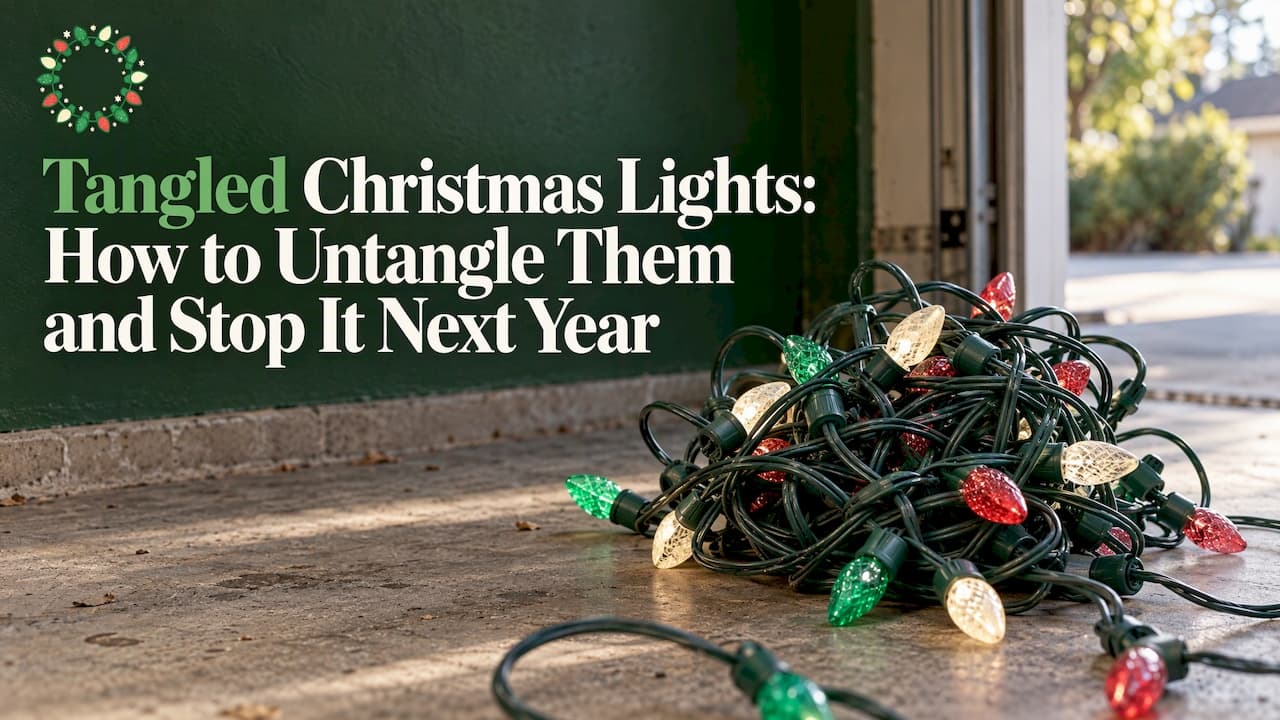
To untangle Christmas lights, unplug them, lay the string on a large flat surface, start at the plug and work through the knots gently. Loosen a tight knot with a pen or pencil instead of yanking. Then inspect the string for damage before you plug it back in. This guide walks through each step, shows how to store lights so they come out clean next November, and explains what to do if you would rather never touch a knot again.
TL;DR
- Unplug first, then lay the whole string out on a flat, open surface so you can see where the knots are.
- Work from the plug end. Loosen tight knots by wiggling a pen or pencil into them. Pulling only tightens the knot and can damage bulbs.
- Inspect every string for frayed insulation, loose connections, bare wire and cracked sockets before you use it. Discard damaged sets.
- Wrap each string separately on a reel or piece of cardboard, label it by location, and keep it dry.
- If you would rather skip the knots and the ladder, we design, install, maintain and take down custom-cut C9 LED lighting across Sonoma and Napa counties.
Table of Contents
- Before you touch the knot
- How to untangle Christmas lights step by step
- What to check once the knots are out
- Why lights tangle in the first place
- How to store lights so they stay untangled
- The real cost of a tangled display
- Our perspective
- Hand it off: professional installation in Sonoma and Napa
- If you are doing it yourself this year
- Questions people ask about tangled lights
- Sources
Before you touch the knot
The first step is the one most people skip: unplug the string. Home safety guidance is blunt that lights should be disconnected from power before you start working through them, to avoid electrical shock. If the lights were on recently, give LED strings five to ten minutes to cool, since bulbs can stay warm.
Next, look at what you have. The U.S. Consumer Product Safety Commission (CPSC) tells consumers to examine a light string visually while it is unplugged, checking for frayed insulation, loose connections and exposed bare wires, and checking the sockets for breaks or cracks. A string that already shows those problems is not worth the effort of untangling. It belongs in the trash, not back on the roofline.
Then find a place to work. A garage floor, a clean driveway, a big table or a hallway rug all work. You want enough room to spread the whole tangle out so each knot is visible. Trying to work through a snarl in your lap, hanging off the edge of a box, is how bulbs get pulled out of sockets.

How to untangle Christmas lights step by step
1. Spread the lights out flat
Tom's Guide recommends laying the lights on a large, flat surface so you can see where each knot sits. Resist the urge to pick up one end and pull. A flat spread shows you which loops are simple overlaps and which are real knots, and most of the tangle turns out to be overlaps.
2. Start at the plug
The same source suggests starting at the plug and moving gently through the string. Starting at one fixed end gives you a reference point. As you free each section, you can lay it out straight and keep it away from the part that is still tangled. HomeServe's guide adds a useful habit: keep freed sections straight and clear of the tangled wires, or wrap the free end around a light holder so it cannot snarl again while you work.
3. Loosen tight knots with a pen or pencil
For a stubborn knot, Tom's Guide advises gently inserting a pen, pencil or another thin object that is not too sharp, then wiggling or twisting it to open space in the wires so you can separate them with your fingers. Go slowly. The goal is to create slack, not to force anything. Yanking tightens the knot and can pull on bulbs and sockets.
4. Work knot by knot
Do not try to solve the whole tangle at once. Pick the loosest-looking knot, free it, lay that section down straight, and move on. If a single knot refuses to give after a few minutes, step away and come back. Frustration is how a ten-minute job becomes a broken string.
5. Keep the order of the string in mind
When you are done, you should have one clean line from plug to the far end. That is the moment to test and inspect, not to coil it into a ball and throw it back in the box.
What to check once the knots are out
Untangling is when damage shows up. Wires that were bent or pinched in a knot, sockets that took a tug, and old insulation that cracked in a cold garage all become visible once the string is laid out straight.
The CPSC's guidance gives a clear routine. Check the string for frayed insulation, loose connections and exposed bare wires, and check each socket for breaks or cracks. After the visual check, place the set on a non-flammable surface and plug it in for 10 to 15 minutes before you decorate with it. If it does not work properly or bulbs do not light, repair or discard it.
A few specifics worth knowing:
- Cracked or broken sockets. The CPSC says a set with broken or cracked sockets should not be used, and it also advises looking inside each socket for properly positioned metal contacts.
- Frayed or bare wire. The Electrical Safety Foundation International (ESFI) warns that cracked or frayed sockets, loose or bare wires and loose connections can cause a serious shock or start a fire.
- Slit insulation or damaged plugs. Popular Mechanics says to discard a string showing cracked or slit insulation, frayed wires or damaged plugs rather than plug it in.
If you are unsure whether a damaged set can be repaired safely, a licensed electrician is the person to ask. For ordinary consumer strings, replacing a damaged set is usually simpler than repairing it.
A quick decision table
| What you find | What to do |
|---|---|
| Knot loosens with a pencil, string works | Keep it, test for 10 to 15 minutes, then use it |
| A few bulbs out, wire and sockets intact | Replace bulbs if the set allows it, then retest |
| Frayed insulation, bare wire or loose connection | Repair properly or discard the set |
| Cracked or broken socket | Do not use the set |
| Damaged plug | Discard the string |
Why lights tangle in the first place
A string of lights is a long, flexible cord with bulbs spaced along it, and bulbs act like hooks. When strings are tossed into a box or bag, movement from carrying, stacking and shifting lets the cord loop over itself and catch on bulbs and plugs. The longer the string and the more strings share a bin, the more places there are to catch.
The other cause is the way lights come down. Pulling lights off a roofline or tree in a hurry, then stuffing them into a bin, builds the knots you fight next year. Taking lights down in the reverse of the path used to put them up, and planning that order ahead, helps reduce tangles.
How to store lights so they stay untangled
The fix is to give each string its own space and its own shape.
- Inspect as you take down. The ESFI advises checking the wiring as lights come down and discarding any with cracked, frayed or damaged insulation. Do not store a damaged string.
- Wrap each string separately. Ace Hardware's storage guidance recommends wrapping lights individually on a storage reel or cardboard organizer and keeping strands separate. A cut piece of cardboard with a notch at each end to hold the plug and the last bulb is enough.
- Use a bin with dividers. The same guidance suggests containers with dividers or separate compartments, so wrapped strings do not slide against each other.
- Label by location. Labeling each set by where it goes, for example "Front Roofline," makes next year's decorating easier. You will not unwrap six strings to find the one that fits the porch.
- Keep indoor and outdoor sets apart. ESFI also advises labeling or storing indoor decorations separately from those meant for outdoor use.
- Store dry and uncrushed. Keep bins in a dry place, off damp floors and away from heavy items that could crush the bulbs, per Ace Hardware.
The whole routine adds maybe twenty minutes per season for a modest display. For a full roofline, a second story and landscaping, it adds a good deal more.
The real cost of a tangled display
The knots are the annoying part. The bigger problem is what comes with them: hauling a ladder out, working along a gutter line, and handling cords near an outlet in cold, wet weather. The CPSC has estimated more than 15,000 holiday decorating injuries during November and December in one of its seasonal releases. Hanging lights is a task that mixes height, electricity and awkward reaching, and untangling is only the first step of it.
That is the reason many homeowners and property managers in Sonoma County hand the whole job off.
Our perspective
We are a firefighter-owned crew, and we think about lights the way we think about any job at height: the safest ladder trip is the one you did not have to make. Most of the calls we get are not about lights. They are about a Saturday that disappeared into a pile of knots, a borrowed ladder and a roofline that never looked quite right.
The tangle is a symptom. It comes from lights that were bought in standard lengths, hung in a rush, pulled down in a rush and thrown in a bin. Our approach removes each of those steps. We use custom-cut C9 LED lighting so each run fits the property, we design the layout before we hang anything, we handle maintenance during the season, and we take everything down carefully and store it.
That is what we mean by all-in-one. You get the lit house, and you do not inherit the box of knots in January. If you love doing your own lights, the steps above will serve you well. If you would rather spend the season with your family or your guests, that is what we are here for.
Allen
Hand it off: professional installation in Sonoma and Napa
If untangling is the part of the season you dread, we take the whole project off your list. A Bright Service Christmas Lights handles design, installation, in-season maintenance, post-holiday takedown and storage for homes, businesses, estates and wineries. We are fully insured, and our crew is firefighter-owned.

For homes, residential Christmas light installation starts at $1 per linear foot. Packages start at $600 for Classic, $1,500 for Signature and $4,000 for Custom Display, all one-off prices as published. Businesses can look at our commercial holiday lighting service, and we also do estate lighting, winery holiday lighting and bundled gutter cleaning. If you are in Santa Rosa, see our Santa Rosa Christmas light installation page, or start from our main site to find your city.
Property managers and business owners who want clear communication and minimal disruption to tenants and customers can read more on commercial Christmas light installation in Sonoma County. If your gutters need attention before lights go up, ask us about gutter cleaning, which we can bundle with the installation.
If you are doing it yourself this year
A short plan helps the season run smoothly:
- Test before you climb. Lay each string out on the ground, inspect it and run it for 10 to 15 minutes on a non-flammable surface, as the CPSC advises. It is much easier to swap a dead string on the driveway than on the roof.
- Hang in a planned order. Decide the path before you start. You will take the lights down along the same path, and a planned order reduces tangles.
- Keep a spare. Having a tested spare string of the same type saves a second trip to the store if one fails.
- Respect the ladder. Have someone steady it, wear shoes with grip, and do not reach past your belt line. Stay away from wet surfaces and from power lines.
- Take down with care. Wrap as you go instead of balling the string up and dealing with it later.
Questions people ask about tangled lights
Can you fix lights that are badly tangled?
Usually, yes, if the wire and sockets are intact. Unplug the string, lay it flat, start at the plug and loosen tight knots with a pen or pencil. Afterward, check for frayed insulation, bare wire and cracked sockets, and discard the set if you find any.
Should I pull on the string to loosen a knot?
No. Pulling tightens the knot and can damage bulbs and sockets. Insert a thin, not-too-sharp object such as a pencil, wiggle it to open space between the wires, and separate them with your fingers.
How do I stop my lights from tangling next year?
Wrap each string separately on a reel or piece of cardboard, keep strands apart in a divided bin, and store them somewhere dry. Labeling each set by location, such as the front roofline, makes it easier to find the right one in November.

Is it safe to plug in lights right after untangling them?
Inspect them first. With the lights unplugged, check for frayed insulation, loose connections, bare wires and broken or cracked sockets. Then plug the set in for 10 to 15 minutes on a non-flammable surface before you hang it, and discard it if it does not work properly.
Can someone else install and store my Christmas lights?
Yes. We design, install, maintain and take down custom-cut C9 LED lighting for homes, businesses, estates and wineries in Sonoma and Napa counties, and we store the lights after the season. Residential installation starts at $1 per linear foot.
Sources
- CPSC Cautions On Christmas Tree Lights
- CPSC: Light Safety
- CPSC: Holiday decorating injuries during November and December
- ESFI: Avoid Serious Electrical and Fire Hazards Decorating Your Home
- Tom's Guide: How to untangle your string lights
- Popular Mechanics: How To Fix Christmas Lights
- Ace Hardware: How to Store Christmas Lights Without Tangles
- HomeServe: How to Untangle and Wrap Holiday Lights and Wires
- Nine: How to untangle Christmas lights
- Home of Strings: How to Remove LED Lights from Christmas String Lights