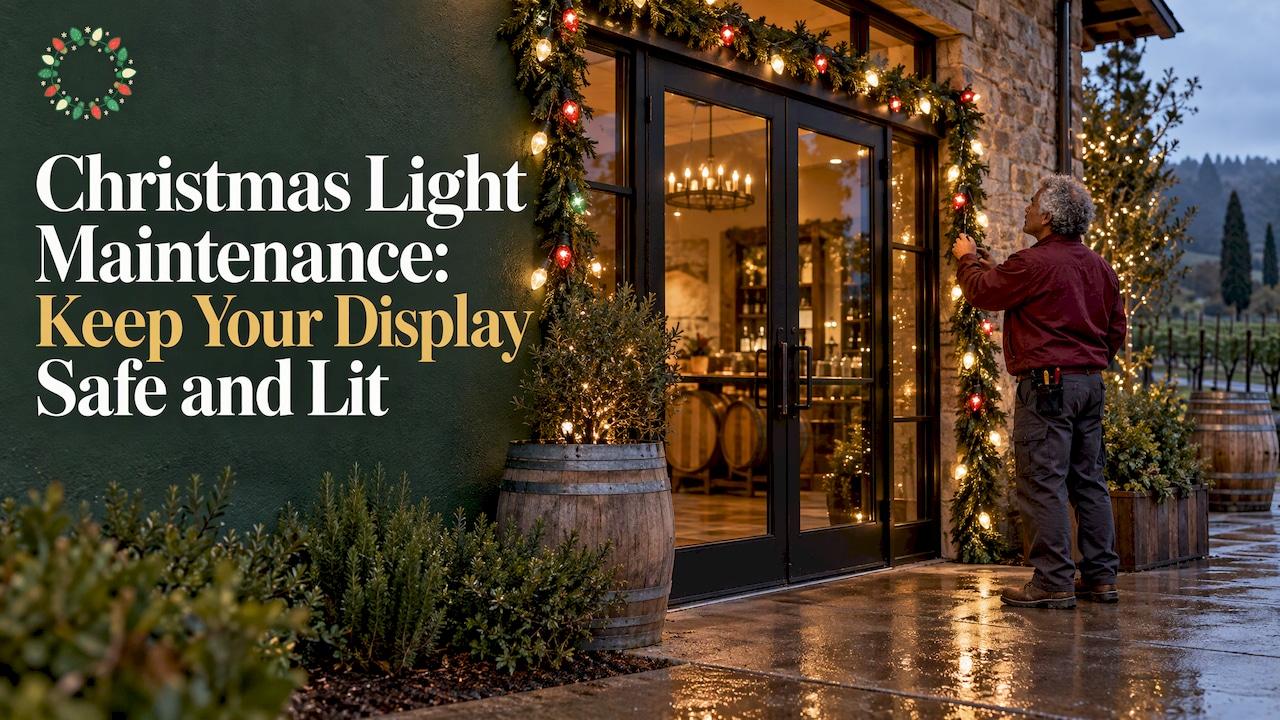
A display that looks perfect on the first night can have a dark section by mid-December. A storm loosens a clip, moisture gets into a plug, or one bad bulb takes out a run. Maintenance is what keeps the display lit and safe until January, and the easiest way to get it is to have the crew that installed your lights stay responsible for them. That is how we work at A Bright Service: design, installation, in-season maintenance, takedown and storage come as one job, so nobody on your staff or in your family has to climb a ladder.
Below is what season-long maintenance involves, what goes wrong most often, and how to decide who should handle it.
TL;DR
- Most holiday light failures come from a few places: loose connections, moisture at plugs, a blown fuse or one bad bulb in a series circuit.
- Federal safety guidance says to turn lights off when you go to bed or leave the house, so put the display on a timer.
- Outdoor lights, cords and extension cords must be rated for wet or damp locations. Damaged sets get replaced, not patched and reused.
- The riskiest part of maintenance is ladder work in December weather, which is the main reason to hand it off.
- Our installations include in-season maintenance, takedown and storage, so one crew handles the whole season.
Table of Contents
- What season-long maintenance actually covers
- The problems that darken a display
- Can Christmas lights stay on all day?
- Repair, replace or hand it off
- What a maintenance plan should include
- Takedown and storage
- Our perspective on maintenance
- Hand the whole season to one crew
- FAQ
- Sources
What season-long maintenance actually covers
Maintenance is not one visit. It is a sequence that starts before the lights go up and ends after they come down:
- Pre-season inspection. Every strand, bulb and cord is checked and the outlets are tested before anything is mounted.
- Post-storm checks. Wind and rain test every clip, anchor and connection.
- Routine checks and repairs. Dark sections, timer drift and loose plugs get fixed as they appear.
- Takedown. Lights come down dry, are coiled loosely and are labeled.
- Storage. Strands are kept somewhere dry and away from pests until next year.
A seasonal calendar from a lighting retailer suggests inspecting every strand, bulb and cord in early fall and walking the display after each big storm. It also suggests a quick check every few weeks, so small problems don't grow (Holiday Light Store).
For a Sonoma or Napa County property, the storm check matters most from late November through December, when rain and wind are most likely. For a winery tasting room, a dealership frontage or a shopping center, a dark stretch also shows from the road.
The problems that darken a display
Loose connections and moisture
Connection points, where one strand plugs into the next or into a cord, are the usual weak spot. Wind moves the strands, and plugs work loose. Moisture then finds the gap. Plugs and splices should be outdoor-rated and should never sit in a puddle or a low spot where water collects. Cords should never run through standing water or a gutter downspout (Holiday Light Store).
The electrical code points the same way. The National Electrical Code (NEC), the standard used for electrical safety in the U.S., requires cords suitable for the location. Outdoor cords must be listed for wet locations, marked with a "W." The same guidance recommends replacing worn or damaged extension cords and light strings instead of reusing them (IAEI Magazine).
If a breaker keeps tripping, moisture in the outlet, lights or cord is a common cause (Family Handyman).

One bad bulb, one dark section
Older incandescent strings are wired as series circuits, so one disconnected or damaged bulb breaks the circuit for its section. If the whole string is dark, a blown fuse is the likely cause. The fuse is in the plug compartment, and a broken filament in the clear tube means it has blown (iFixit). If only half the strand is out, the bad bulb is often the first dark one (Family Handyman).
Flickering LEDs have their own causes. A symptom-first walkthrough on diagnosing LED flicker helps you tell a loose connection from a power problem. Our own guide, Christmas Lights Not Working? Find the Cause and Fix It, covers the same ground for outdoor displays.
Timer and overload problems
A timer that drifts can leave lights burning all night. Overloading is the other quiet risk. One manufacturer's C9 LED guide rates a 75-count string at 4.32 watts and allows end-to-end connections totaling no more than 216 watts (1.8 amps). It also says that if a replacement fuse blows again, a short circuit may be present and the product should be discarded (GE C9 LED user guide). Always check the limits printed on your own product's label or guide before connecting strands end to end.
Can Christmas lights stay on all day?
No. The U.S. Consumer Product Safety Commission says to turn off all holiday lights when you go to bed or leave the house, because lights can short out and start a fire (CPSC). The GE guide also tells users to unplug the lights when leaving, retiring for the night or leaving them unattended.
The practical answer is a timer or photocell, so the display comes on at dusk and shuts off on its own. One home-building guide suggests no more than 6 hours a night (Build-Construct). For a business, set the hours to match when customers and guests are actually there.
Two more rules apply:
- Rating. Outdoor displays need lights marked for wet locations, while covered spots like porches and eaves can use damp-rated lights (Build-Construct).
- Duration. NEC 590.3(B) allows temporary decorative lighting to stay up for up to 90 days. Decorative strings must also carry a third-party listing such as UL, CSA or ETL (IAEI Magazine). Property managers whose lights go up in November and come down in January fall inside that window.
For more on fire risk, see our guide to Christmas light fire hazards.
Repair, replace or hand it off
Some problems are fixable and some are not. The CPSC says to check each set for broken or cracked sockets, frayed or bare wires and loose connections, and to throw out damaged sets (CPSC).
Use this rule of thumb:
| Symptom | Usual cause | What to do |
|---|---|---|
| One section dark | Bad bulb or loose bulb in socket | Replace or reseat the bulb |
| Whole strand dark | Blown fuse or loose plug | Replace the fuse, check the plug |
| Breaker keeps tripping | Moisture or a short | Unplug the display and have it inspected |
| Cracked socket, bare wire | Physical damage | Retire the set |
| Same fuse blows twice | Possible short circuit | Discard the strand |
The fix itself is rarely the hard part. The hard part is reaching the problem. A dark section on a second-story roofline means setting a ladder on wet ground in December, and a fall is a worse outcome than a dark bulb. Our guide to ladder safety for Christmas lights explains the risks. If a repair is above the first floor, or a breaker trips and you don't know why, call us instead of improvising. We cover the decision in Christmas Light Repair in Sonoma: Fix It or Hand It Off.
What a maintenance plan should include
Whether you are a homeowner or a property manager, a good plan answers these questions up front:
- Who installed the lights, and who fixes them? Split responsibility is where dark sections linger.
- Does maintenance run all season? A plan that covers only the install day is not a maintenance plan.
- Who takes the lights down and where do they go? Takedown and storage should be part of the same arrangement.
- Is the crew insured? Work at height on your property should be done by a fully insured team.
- Is the warranty clear? Our guide to what an installation warranty should cover lists what to ask.
Our approach bundles these. We design the display, install custom-cut C9 LED lights fitted to your roofline, maintain it through the season, take it down and store it. The crew is fully insured, and the company is firefighter-owned. For commercial properties that means one point of contact for tenants and customers instead of several vendors. You can read more in Christmas Light Installation and Maintenance in Santa Rosa.
Takedown and storage
Maintenance ends well or badly at takedown. The retailer calendar above recommends taking the display down in early January while the weather is still mild and dry. Unplug everything first and let each strand dry completely. Coil strands loosely rather than wrapping them tightly, label each coil with its location and any fault notes, and keep bulbs separate in padded containers. Store everything dry and cool, away from pests and moisture (Holiday Light Store).

Labeling with fault notes pays off next November, because the problem strand is already marked. Tangles are the other cost of careless takedown, and our guide to untangling Christmas lights covers how to avoid them. Our service takes this off your list: we handle the takedown and storage as part of the job. See how to take Christmas lights down for timing.
Our perspective on maintenance
Most people think about Christmas lights as an installation day. We think about them as a month-long responsibility. The display is on your roof, along your storefront or across your winery's entrance every night, and a dark section or a loose cord says something about your property.
That is why we keep design, installation, in-season maintenance, takedown and storage under one crew. The people who measured and cut your C9 LED lights are the ones who know where each run connects, so a problem gets traced to its source instead of guessed at. Being firefighter-owned shapes how we see the job: we take safety seriously, from ladder work to how a display is powered.
For a homeowner, the result is a display you enjoy with your family instead of a weekend spent on a ladder. For a hotel, dealership or shopping center, it is lighting that stays reliable without pulling your staff away from guests and customers.
Allen
Hand the whole season to one crew
If you want the display lit and safe from the first night to takedown, our residential service starts at pricing that fits most homes. Classic starts at $600, Signature at $1,500 and Custom Display at $4,000, with installation priced from $1 per linear foot. Each is a one-time price for the installed display, and the maintenance, takedown and storage described above are part of how we work. See the options on our residential Christmas light installation page.

For larger properties, we also handle commercial, estate and winery lighting across Sonoma and Napa counties. Gutter cleaning can be bundled in, which keeps the roofline clear before the lights go up. Reach us through A Bright Service.
FAQ
How often should Christmas lights be checked during the season?
Check them after every big storm and give them a quick look every few weeks, as the seasonal guidance above suggests. A short check after a storm can save much longer troubleshooting later. With our service, the in-season maintenance is ours to handle.
Can you pay someone to put Christmas lights up and maintain them?
Yes. We design, install, maintain, take down and store the lights for homes, businesses, estates and wineries in Sonoma and Napa counties. Putting one crew in charge of the full season keeps the responsibility in one place.
How do I find the bad bulb on a strand?
If half the strand is out, start with the first dark bulb. If the whole strand is dark, check the fuse in the plug and then the bulbs one at a time. Unplug the strand before touching any bulb or socket. If the problem is out of easy reach, or a breaker keeps tripping, have it inspected.
How do I keep moisture out of outdoor lights?
Use outdoor-rated plugs, splices and cords marked for wet locations, and keep connections off the ground and out of low spots where water collects. Replace any worn or damaged cord rather than reusing it.
Is it safe to leave lights on overnight?
No. The CPSC advises turning off holiday lights when you go to bed or leave home. A timer or photocell does this automatically every night.
Sources
- CPSC: Do's and Don'ts of Holiday Decorating
- IAEI Magazine: Electrical Safety Tips for the Holidays
- Family Handyman: Why Are My Christmas Lights Not Working
- iFixit: Half of Christmas String Lights Won't Light Up
- GE C9 LED light user guide
- Build-Construct: Outdoor Christmas Lights
- Holiday Light Store: Maintain Outdoor Holiday Light Displays