
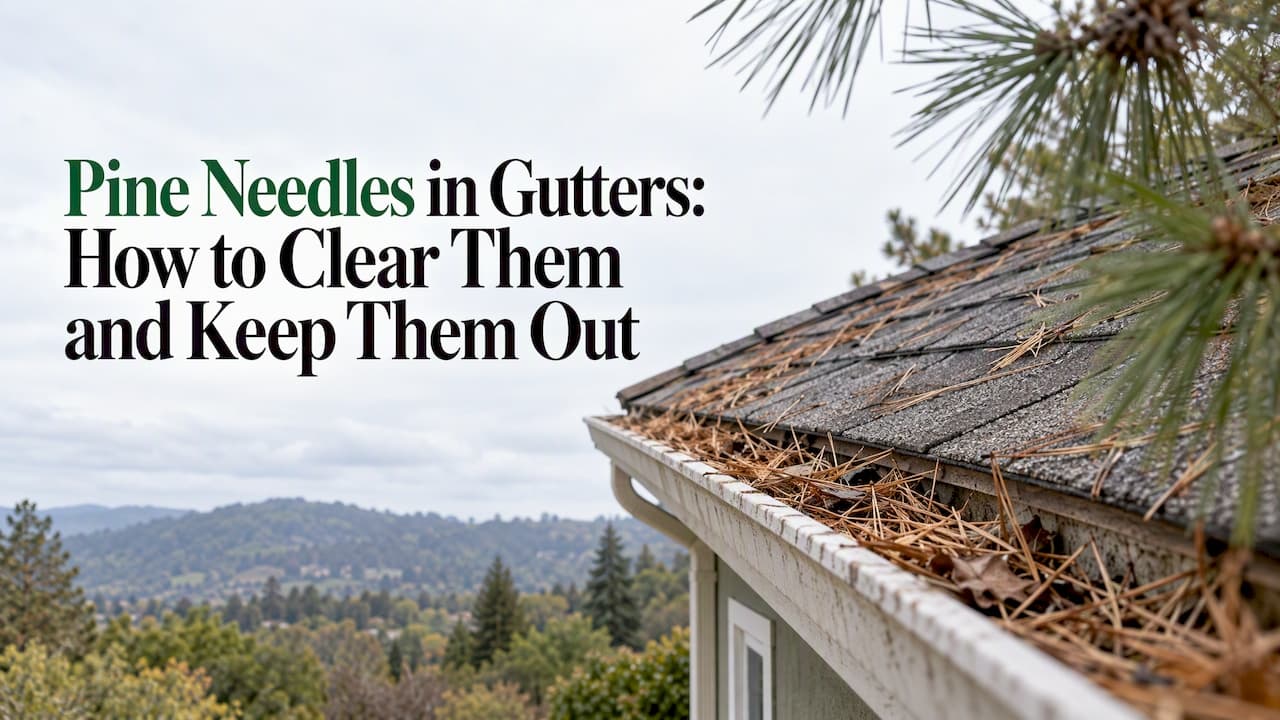
Pine needles in gutters need to come out by hand or with a scoop, followed by a hose flush, and the downspouts need checking too. Then you need a plan so they don't pile up again: trim overhanging branches, add fine micro-mesh guards if you want fewer cleanings, and check on a schedule. Needles are thin, light and constant, so they pack into gutters faster than leaves do. In Sonoma County they also matter for fire safety, because dry debris in a gutter can catch wind-blown embers.
Below you will find how to remove needles safely, how to clear a stuck downspout, what gutter guards can and can't do, how often to check, and when it makes sense to hand the job to a crew.
TL;DR
- Needles mat together when wet, block water flow, add weight and can pull gutters away from the fascia.
- Scoop the debris out by hand, flush with a hose from the far end toward the downspout, then clear the downspout.
- Micro-mesh guards with openings of 275 microns or smaller can block pine needles, but they still need occasional cleaning.
- Dry needles in gutters are fuel for embers, so keep gutters clear before and during fire season.
- Ladder falls injure thousands of people every year. If you don't want to climb, hire an insured crew.
Table of Contents
- Why pine needles clog gutters so easily
- What happens when needles are left in place
- The fire angle: why needles in gutters matter in Sonoma County
- How to remove pine needles from gutters, step by step
- What about needles on the roof?
- Will gutter guards keep pine needles out?
- How often should you clean?
- Perspective: why we clear gutters before we hang lights
- When it makes sense to hire a crew
- Gutter cleaning and holiday lights from one crew
- FAQ
- Sources
Why pine needles clog gutters so easily
A maple leaf lands on a gutter and mostly sits there. A pine needle slips in, lies along the channel and weaves with its neighbors. When rain hits, the needles swell into a dense mat that holds water instead of passing it on. According to one roofing company's guide, their slender shape lets them align with the gutter interior and clump when wet. That is exactly what you see when you climb up and find a brown, felted layer along the whole run.
Two other things make needles harder than leaves:
- They fall year-round. Evergreens and conifers can drop needles throughout the year, not only in autumn, so a gutter you cleaned in October can be partly filled again by spring.
- They don't stay where they land. Needles slide down the roof, catch on the edge and settle in the gutter, and they can also lodge in the downspout opening and the elbow below it.
If you have a pine, fir, cedar or redwood within reach of your roof, plan for this to repeat. The goal is not a gutter that never gets needles. The goal is a gutter that never stays clogged.
What happens when needles are left in place
A small amount of debris is harmless. A packed gutter is not. The problems stack up in a predictable order.
- Water backs up and overflows. Water spills over the edge instead of reaching the downspout, which can lead to fascia and soffit rot, foundation erosion and sagging from the weight of saturated debris.
- Gutters sag and pull away. Trapped moisture and added weight can make gutters separate from the fascia, crack, or develop rust spots.
- Water finds the roof edge. A blocked gutter can push water back under the lowest shingles, which can soak the decking and underlayment and eventually leak indoors.
- Wood stays damp. Constant moisture along the fascia board is how rot starts, and rot is a repair bill far larger than a cleaning.
In colder parts of the country, standing water also freezes into ice dams. That is less of a concern in most of Sonoma County, but the other four problems apply anywhere it rains.
The fire angle: why needles in gutters matter in Sonoma County
If you live in wine country, this is the reason to take the job seriously. Embers travel ahead of a wildfire, and they land on whatever is dry and loose. Gutters are a catch basin for exactly that.
The Santa Barbara Fire Safe Council explains that wind-blown embers can ignite pine needles and other debris in gutters, and that fire can then reach the roof, eaves, siding and attic. Utah State University Extension makes the same point in its ember checklist: needles in rain gutters can fuel ignition, so gutters should be kept free of plant debris during fire season.
CAL FIRE's defensible space guidance puts it in the first zone around the house: remove leaves, needles and other debris from your roof, gutter, deck and porch. The same guidance calls the first five feet from the home the most important area.
Two practical takeaways:
- A clean gutter is part of wildfire preparation, not just rainwater maintenance. Do the cleaning before the dry season peaks and again after heavy needle drop.
- Metal gutters are the better choice in fire-prone areas. The Santa Barbara Fire Safe Council notes that non-combustible materials such as metal outperform plastic or vinyl when embers are a concern.
How to remove pine needles from gutters, step by step
You can do this yourself on a single-story house with a sound ladder and a free afternoon. Here is the sequence a careful crew follows.
Set up safely first
The ladder is the real danger in this job. NIOSH reports that more than 100 people die and thousands more are injured each year in the U.S. from ladder-related falls. In roughly 40% of cases, the leading cause is the base sliding out because of a wrong setup angle. Overreaching and carrying objects up the ladder are also common causes.
Before you climb:
- Put the ladder on firm, level ground and set it at the correct angle. NIOSH offers a free Ladder Safety app with an angle indicator.
- Choose a non-conductive ladder (fiberglass) and keep it well clear of power lines at the service drop.
- Wear gloves with grip and eye protection. Dry needles are sharp and dust falls into your face.
- Move the ladder instead of reaching. Keep your belt buckle between the rails.
- Don't work alone, and skip it in wind or on wet ground.
Clear the debris
- Scoop by hand or with a gutter scoop. Work away from the downspout so you don't push the debris into the outlet. Drop it into a bucket hung from the ladder, or onto a tarp below.
- Break up the mat. A dense felted layer often lifts in one piece. Pull it out rather than trying to rinse it.
- Flush with a hose. Start at the end farthest from the downspout and run water toward it. The standard approach is scoop first, then flush. Watch the flow: it should move steadily to the outlet.
- Check the pitch. If water pools in one spot after flushing, the gutter may have sagged or the hangers may have loosened.
- Clean up the ground. Rake or bag the needles and keep them away from the foundation and the first five feet of the house.
A leaf blower with an extension tube is popular for dry needles. It is quick, but wet needles stay put, and you still have to deal with the downspouts. Blowing from the ground level is safer than blowing from a ladder.
Clear a blocked downspout
Needles that wash down tend to jam at the first elbow. Try these in order:
- Flush from the top with a garden hose. If water backs up, the clog is lower down.
- Flush from the bottom up. Pushing water upward from the outlet can break up debris packed in the lower elbow.
- Use a small auger or plumber's snake from the top or bottom to break through the packed debris.
If the same downspout clogs again and again, the problem may not be the needles. The same guide says the slope of the gutter or the size of the outlet may need fixing, and that is a job for a gutter installer.
What about needles on the roof?
Needles on the roof feed the gutters, and on a steep or old roof they are a fall risk. Never walk on a wet, mossy or steep roof to clear them. Wet needles are slippery, and some roofing materials, such as tile and aged composition shingles, can crack under foot.
Safer options:
- Use a soft-bristle push broom or a roof rake from the ground or a stable ladder, sweeping downward, never against the shingle edges.
- Use a leaf blower on low power to move dry needles down and off the roof, then clear the gutter afterward.
- Skip pressure washing. High pressure can strip granules and force water under shingles.
- For steep, tall or tile roofs, call a professional who works with fall protection.
Will gutter guards keep pine needles out?
Some will, and some will make things worse. The type and the mesh size decide.

This Old House tested guards against pine needles and found that micro-mesh with openings of 275 microns or smaller can block them. Their top pick used a stainless steel micro-mesh that stopped both long and short needles in testing. They also caution that guards are not maintenance-free: they can sag over time and collect debris on top.
A quick guide to what that means for you:
| Guard type | Pine needle performance | What to know |
|---|---|---|
| Wide-hole screens or perforated metal | Poor | Needles can poke through and settle in the gutter, and they snag on top |
| Plastic snap-in inserts | Poor to fair | Can trap debris on the surface and are a weaker choice where embers are a concern |
| Fine stainless micro-mesh (275 microns or smaller) | Best of the common options | Needs occasional brushing or rinsing of the surface, and needs a good fit so it doesn't sag |
| No guard, with scheduled cleaning | Depends on your routine | Lowest upfront cost, and works if you stay on the schedule |
One fire-safety note: needles that collect on top of a mesh cover are still fuel. A fire safety source warns that pine needles can accumulate on mesh covers and create a hazard when they are left there, so guards don't remove the need to look at the gutters in fire season.
How often should you clean?
There is no single number, because it depends on how close the trees are and how much they shed. A sensible baseline looks like this:
- Twice a year at minimum, typically in spring and fall, for homes with little tree cover.
- More often when trees overhang the roof. One roofing guide suggests checking every 6 to 8 weeks during peak shedding in late spring and fall, and after strong winds or storms.
- Before fire season, and again once the first heavy needle drop is down.
In practice, look up after every windy day. If you can see needles or a line of green or brown at the gutter edge from the ground, it is time. Trimming branches that hang over the roofline is the single biggest reduction in work, and a licensed tree service can do it safely. Keep trimmed material clear of the house.
Perspective: why we clear gutters before we hang lights
We are firefighter-owned, so we look at a roofline differently than most decorators do. Before we think about lights, we look at what is sitting in the gutter, because a gutter full of dry needles is a risk in our county, and it is also the first thing to fail under the weight of lights and a wet December.
The ladder is where most homeowners get hurt. We would rather you stay on the ground. Our crew is fully insured, we bring the right equipment, and we do the work the same way every time: clear the debris, check that the gutters are secure, then mount custom-cut C9 LED lights so each run fits the property.
That is why we bundle services. When gutter cleaning, design, installation, in-season maintenance, takedown and storage come from one team, you don't coordinate three vendors or climb a ladder twice. Your roofline is cleaner and safer, and the lights go up on a surface that is ready for them.
Allen
When it makes sense to hire a crew
Doing it yourself works if you have a one-story home, a solid ladder and the time. Hiring makes sense when:
- The gutters are on a second story or a steep roofline.
- Trees overhang the roof and the needles come back every few weeks.
- You have a wine estate, a long set of eaves or multiple buildings.
- You manage a property and need the work documented and repeated on a schedule.
- You want to be done before the holidays, with lights going up soon after.
When you hire, ask for proof of insurance, ask whether the crew flushes downspouts as well as clearing the channels, and ask how debris is removed from the property. A good crew also tells you about loose hangers, sagging runs and standing water, so a small repair doesn't become fascia rot.
Gutter cleaning and holiday lights from one crew

We at A Bright Service handle gutter cleaning in Sonoma County for homes, estates and businesses, and we can bundle it with holiday lighting so the roofline is ready before the first light goes up. We have no published price for gutter cleaning, so ask us for a quote based on your roofline.
Our residential Christmas light installation covers design, custom-cut C9 LED lights, professional mounting, maintenance through the season, takedown and storage. Published prices start at $600 for Classic, $1,500 for Signature and $4,000 for Custom Display, and installation is priced from $9 per linear foot. We also serve businesses, estates and wineries, and work in Santa Rosa, Windsor, Petaluma, Rohnert Park, Healdsburg and across Sonoma and Napa.

If your gutters are full of needles and you want the job done by an insured crew, get in touch with us and we will set up a visit.
FAQ
How do you get pine needles out of gutters fast?
Scoop out the mat by hand or with a gutter scoop, working away from the downspout, then flush with a hose from the far end. Dry needles can also be moved with a leaf blower fitted with an extension tube. Always set the ladder at the right angle and don't overreach.
Will gutter guards keep out pine needles?
Fine micro-mesh with openings of 275 microns or smaller can block them, according to This Old House's testing. Wide-hole screens and many inserts let needles through or collect them on top. Even good guards need occasional cleaning because debris can sit on the surface.
Are pine needles in gutters a fire hazard?
Yes. Wind-blown embers can ignite dry needles in a gutter, and fire can then spread to the roof, eaves and attic. CAL FIRE's defensible space guidance tells homeowners to remove needles and debris from the roof and gutters. Keep them clear throughout fire season.
How often should I clean gutters with pine trees nearby?
A minimum of twice a year, in spring and fall, is the usual baseline. With pines overhanging the roof, check every few weeks during heavy shedding and after storms. Trimming overhanging branches reduces how often you need to do it.
Sources
- Pine Needles in Gutters: Prevention, Cleanup, and Maintenance
- How Pine Needles Damage Roofs and Gutters
- How Pine Needles Clog Gutters And What To Do About It
- Gutters chapter, Wildfire Home Hardening Guide, Santa Barbara Fire Safe Council
- Protect Your Home from Wildfire: Ember Awareness Checklist, Utah State University Extension
- Defensible Space, CAL FIRE
- Falls from ladders are preventable, NIOSH
- How To Clean Gutters Safely: Step-by-Step Guide
- How to Unclog a Downspout (Step by Step)
- How Do I Unclog Gutters and Downspouts
- Best Gutter Guards for Pine Needles of 2026 (Tested), This Old House